Science 8
Unit 1 Study Guide: Matter and Its Interactions
Test: Friday, September 4, 2026 · Classification, atomic structure, and the periodic table.
This page is for studying, it is not the test and nothing on it is graded. Content matches exactly what was reviewed in class; the practice questions below are new, written to match, not copies of any quiz. Ranked trend comparisons (atomic radius, electronegativity) are not on this test.
Classifying Matter: Element, Compound, Mixture
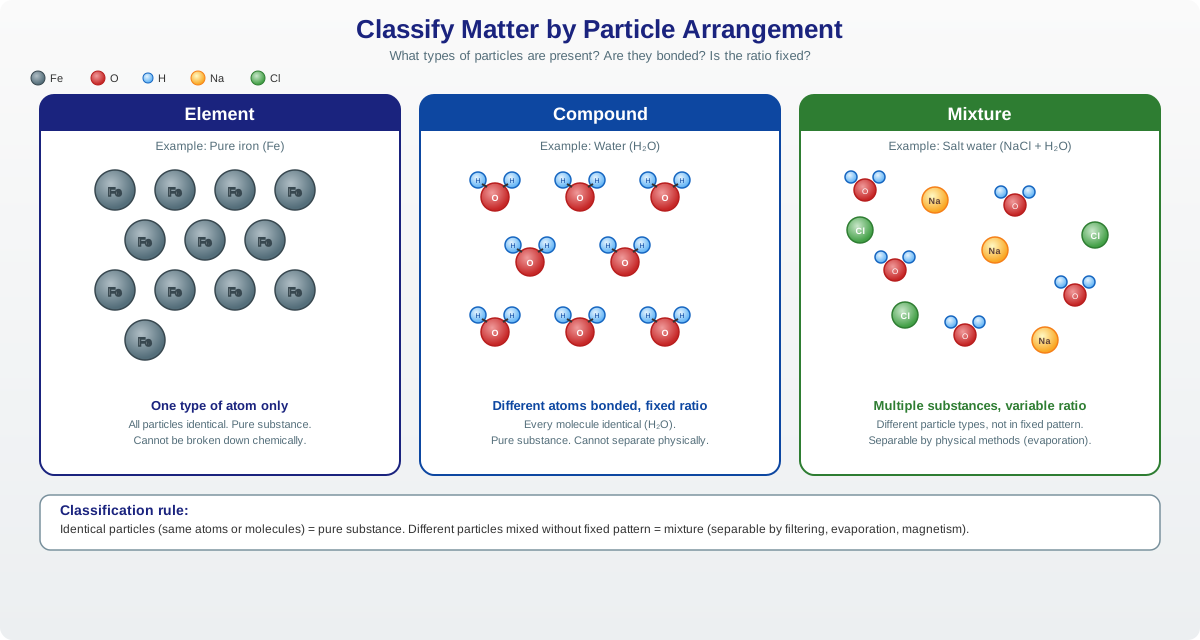
Watch out for sugar water
It looks uniform whether it's a compound or a mixture, so don't judge by appearance. Sugar dissolved in water can be recovered unchanged by evaporating the water away, that's the evidence that dissolving is physical, not chemical, and that sugar water is a (homogeneous) mixture.
Why bonding matters
Sand and iron filings separate with a magnet; salt (NaCl) does not separate the same way. The reason is chemical bonding, not difficulty: sodium (a soft reactive metal) and chlorine (a toxic gas) bonded together form a completely new substance with its own properties, an edible compound.
| element | A pure substance made of only one type of atom, regardless of whether the sample is solid, liquid, or gas. |
| compound | Two or more different types of atoms chemically bonded together in a fixed ratio. |
| mixture | Two or more substances physically combined without any chemical bond, each one keeping its own identity. |
| pure substance | Matter made of only one type of particle throughout, with consistent properties. Elements and compounds are both pure substances; mixtures are not. |
| chemical bond | A force that holds two or more atoms together as a single unit. |
| fixed ratio | The exact, unchanging combination of atoms present in every single molecule of a given compound. |
| chemical formula | A shorthand for a compound's fixed ratio. For example, H2O means two hydrogen atoms bonded to one oxygen atom in every molecule. |
| compound naming | Metal name first, nonmetal second, nonmetal ending changed to -ide. Example: sodium + chlorine → sodium chloride. |
Try it: Oil and vinegar are shaken together but separate again when left standing. Element, compound, or mixture?
Mixture. No new substance formed, no fixed ratio, and they separate back out, no bonding occurred. If they had chemically bonded into a compound, they would not un-mix on their own just by sitting still.
Try it: Name the compound formed from potassium (K) and bromine (Br).
Metal first, nonmetal second with -ide ending: potassium bromide. Same pattern as sodium + chlorine → sodium chloride.
Try it: Read the formula CO₂. How many total atoms are in one molecule, and of what elements?
3 atoms total: 1 carbon, 2 oxygen. The subscript 2 after the O counts the oxygen atoms only; it never means "2 molecules." Reading a subscript as a molecule count instead of an atom count is the single most common mistake with chemical formulas.
Try it: Sugar dissolves completely in water and the mixture looks perfectly uniform. Does looking uniform mean it must be a compound?
No. Appearance alone can't tell you element, compound, or mixture, sugar water looks just as uniform as a true compound would. The real evidence: evaporate the water away and the sugar comes back completely unchanged. Nothing new was created and nothing was destroyed, which is exactly what a physical mixture does and a chemical bond does not.
Atomic Structure
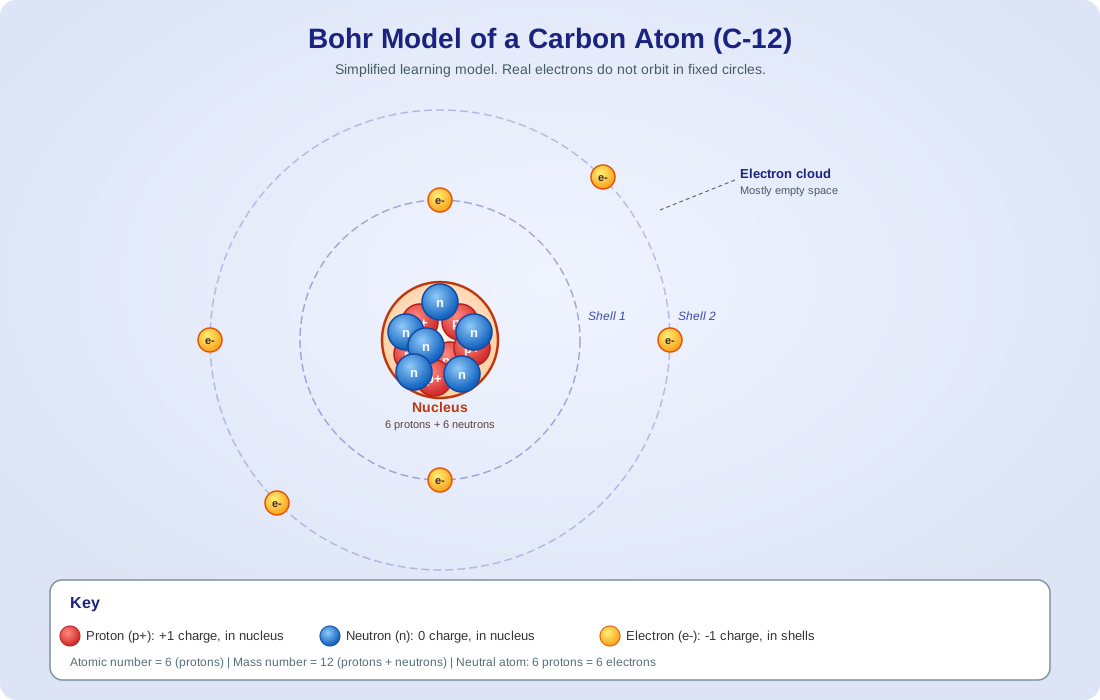
| nucleus | The small, dense region at the center of an atom, made of protons and neutrons. |
| proton | A subatomic particle in the nucleus with a positive charge. Proton count defines the element. |
| neutron | A subatomic particle in the nucleus with no charge. |
| electron | A subatomic particle with a negative charge, found in a much larger region surrounding the nucleus. |
| proton count | Defines the element. Two atoms with the same proton count are the same element, no matter how many neutrons they have. |
| mass number | Protons + neutrons. Estimate neutrons by rounding atomic mass to the nearest whole number and subtracting the atomic number. |
| neutral atom | An atom whose number of electrons equals its number of protons, so its overall charge is zero. |
Common mistake
The nucleus is tiny compared to the electron region, but it holds nearly all the atom's mass, because protons and neutrons carry the mass, not because of size. Don't assume the bigger region (electrons) must hold more mass.
Try it: An atom has 12 protons and an atomic mass of about 24. How many neutrons does it have?
24 (rounded mass) − 12 (protons) = 12 neutrons. Mass number is protons plus neutrons, so once you know the element's proton count from the periodic table, subtracting it from the rounded atomic mass is all it takes.
Try it: An atom has 17 electrons and is neutral. How many protons does it have?
Neutral means electrons = protons, so 17 protons. (That also identifies the element itself: 17 protons is chlorine.)
Try it: Two atoms both have 8 protons, but one has 8 neutrons and the other has 10. Are they the same element?
Yes. Element identity is decided by proton count only. Neutron count can vary without changing what element it is, only proton count can do that.
Try it: Where is almost all of an atom's mass located, and why isn't it in the electron region even though that region is much bigger?
Almost all the mass is in the nucleus, because protons and neutrons are the particles that actually carry mass; electrons contribute barely any. Size and mass are two separate things here: the electron region is large in space, but nearly empty in mass.
The Periodic Table
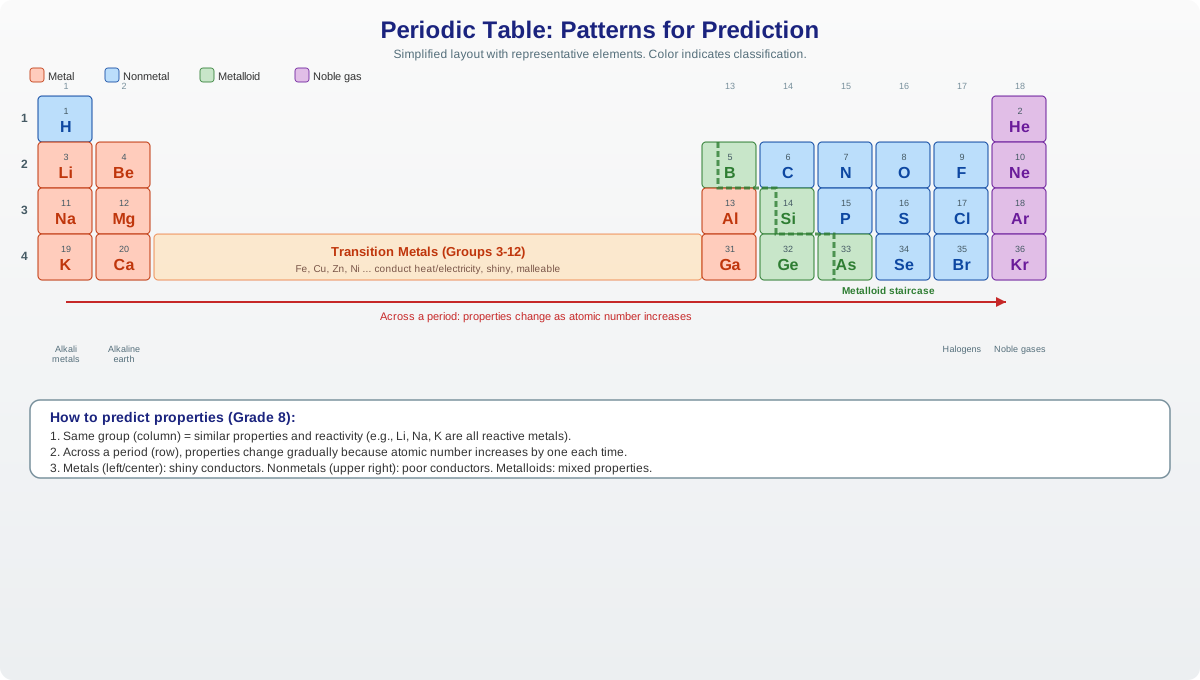
| group (column) | Elements sharing similar properties and reactivity. |
| period (row) | Properties changing across a repeating cycle. |
| the staircase | Metals sit to its left, nonmetals to its right, metalloids sit on it. |
| valence rule | Full outer shell = unreactive (noble gases). One valence electron = highly reactive (alkali metals). |
Ten groupings to know
Alkali metals, alkaline earth metals, transition metals, post-transition metals, metalloids, nonmetals, halogens, noble gases, lanthanides, actinides.
Periodic table reference
Try it: An element has one electron in its outer shell. Is it likely reactive or unreactive?
One valence electron means it's highly reactive, like an alkali metal. It readily gives up that one electron to bond with another atom, which is exactly why alkali metals react so violently with water.
Try it: Is the periodic table ordered alphabetically?
No. It's ordered by atomic number (proton count), left to right, top to bottom, not alphabetically and not by when each element was discovered.
Try it: An element has a completely full outer shell of electrons. Is it likely reactive or unreactive, and what group is it probably in?
Unreactive, and it's probably a noble gas. A full outer shell means the atom has no "incentive" to bond, gain, or lose electrons, which is why noble gases are found mostly as single, unbonded atoms.
Try it: Using the table above, is silicon (Si) a metal, a nonmetal, or a metalloid? How can you tell just from where it sits?
Metalloid. It sits directly on the staircase line, which is exactly the group of elements that share properties of both metals and nonmetals; anything left of the staircase is a metal, anything to its right is a nonmetal.
Start here: lab + videos
Naming Molecules & Compounds lab · drag-atom builder, 60 naming levels, straight practice for the compound-naming rule above
Video: Properties of Elements (Generation Genius) · covers both classification and the periodic table sections
Video: Atoms & Molecules (Generation Genius) · covers the atomic structure section
Video: Chemical Reactions (Generation Genius, background only, chemical reactions themselves are not on this test)
Also on the site
Kris Tyte, Math & Science 7 · East Voyager Academy of Charlotte
[email protected] · (704) 574-9605
[email protected] · (704) 574-9605