Unit 1 Study Guide: Single-Celled Organisms & Cell Structure
Test: Friday, September 4, 2026 · Microscope skills, four organisms, organelles, reproduction.
This page is for studying, it is not the test and nothing on it is graded. Content matches exactly what was reviewed in class; the practice questions below are new, written to match, not copies of any quiz.
The Seven Basic Functions of Life
Nutrition, respiration, excretion, sensitivity, movement, growth, reproduction, plus homeostasis holding them all together.
| nutrition | Getting energy/nutrients, e.g. Amoeba's phagocytosis or Euglena/Volvox's photosynthesis. |
| respiration | Releasing energy stored in food. Not breathing with lungs, every single cell does this. |
| excretion | Removing waste, e.g. the contractile vacuole pumping out excess water. |
| sensitivity | Detecting and responding to the environment, e.g. Euglena's eyespot responding to light. |
| movement | Changing position or moving a body part, e.g. Amoeba flowing forward with a pseudopod, or Paramecium beating its cilia. |
| growth | Increasing in size or, for a single-celled organism, building the materials needed before it divides. |
| reproduction | Producing offspring; can happen asexually (one parent) or sexually (two parents), see the reproduction section below. |
| homeostasis | Keeping internal conditions stable enough for all the other functions to keep happening. |
Try it: Name the basic function of life a contractile vacuole performs.
Try it: Euglena swims toward a patch of sunlight. Which two basic functions does that single action involve?
The Four Organisms: Amoeba, Paramecium, Euglena, Volvox
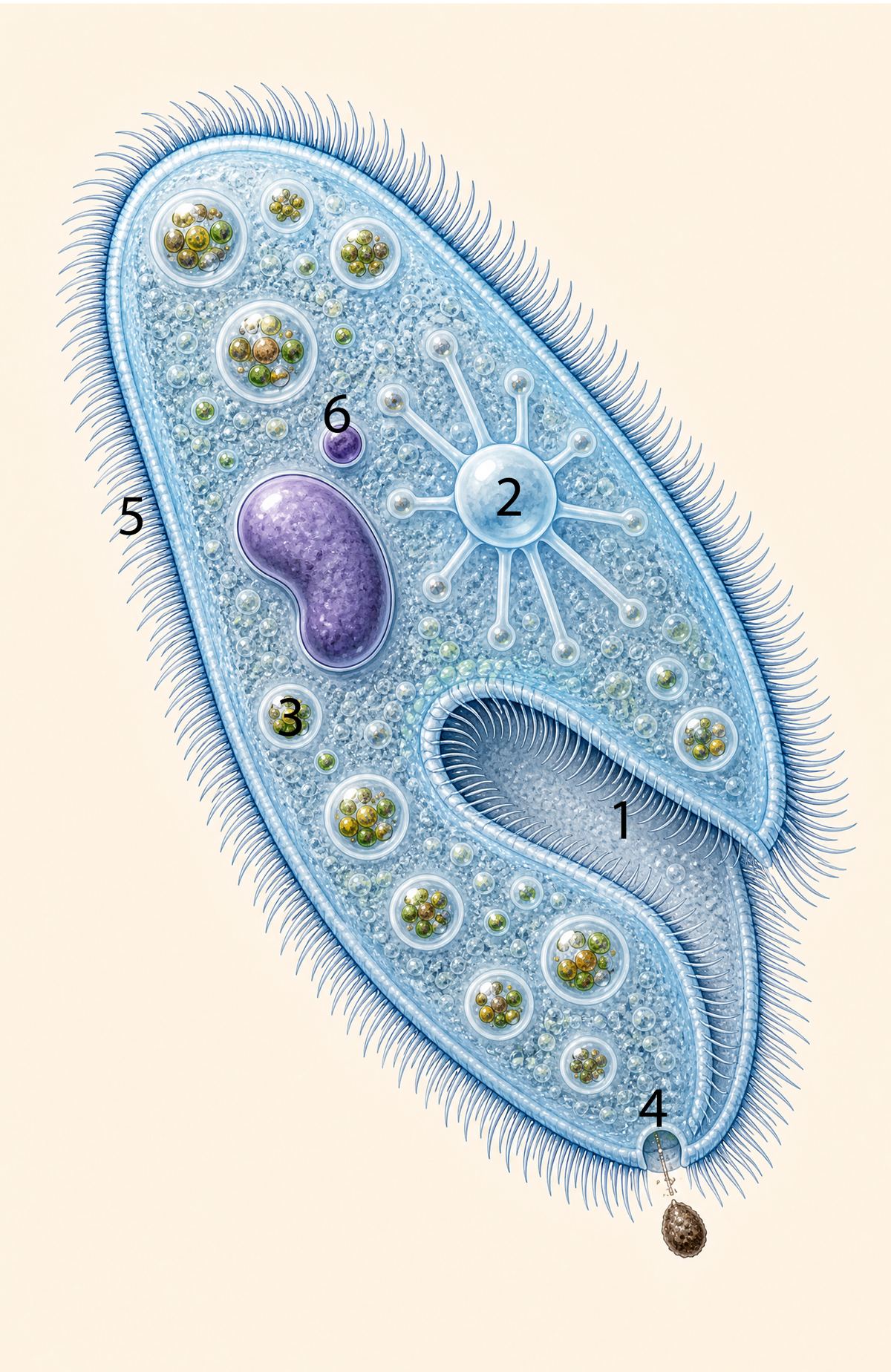
Paramecium
Cilia (many short, hair-like structures) beat together for fast, controlled movement. Contractile vacuole pumps out excess water.
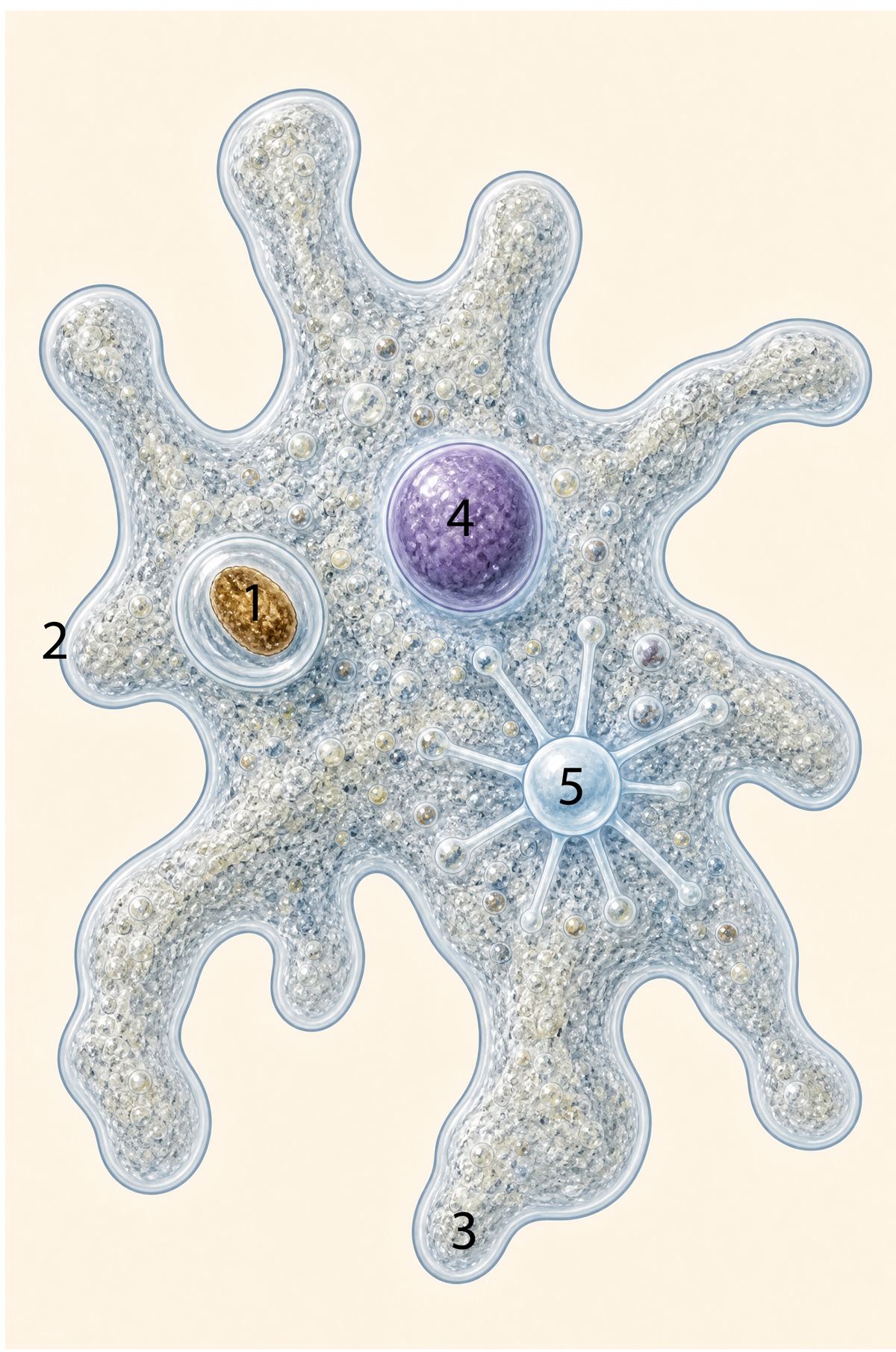
Amoeba
Pseudopods (temporary false feet) for movement and phagocytosis, surrounding and engulfing food. Contractile vacuole for water balance.
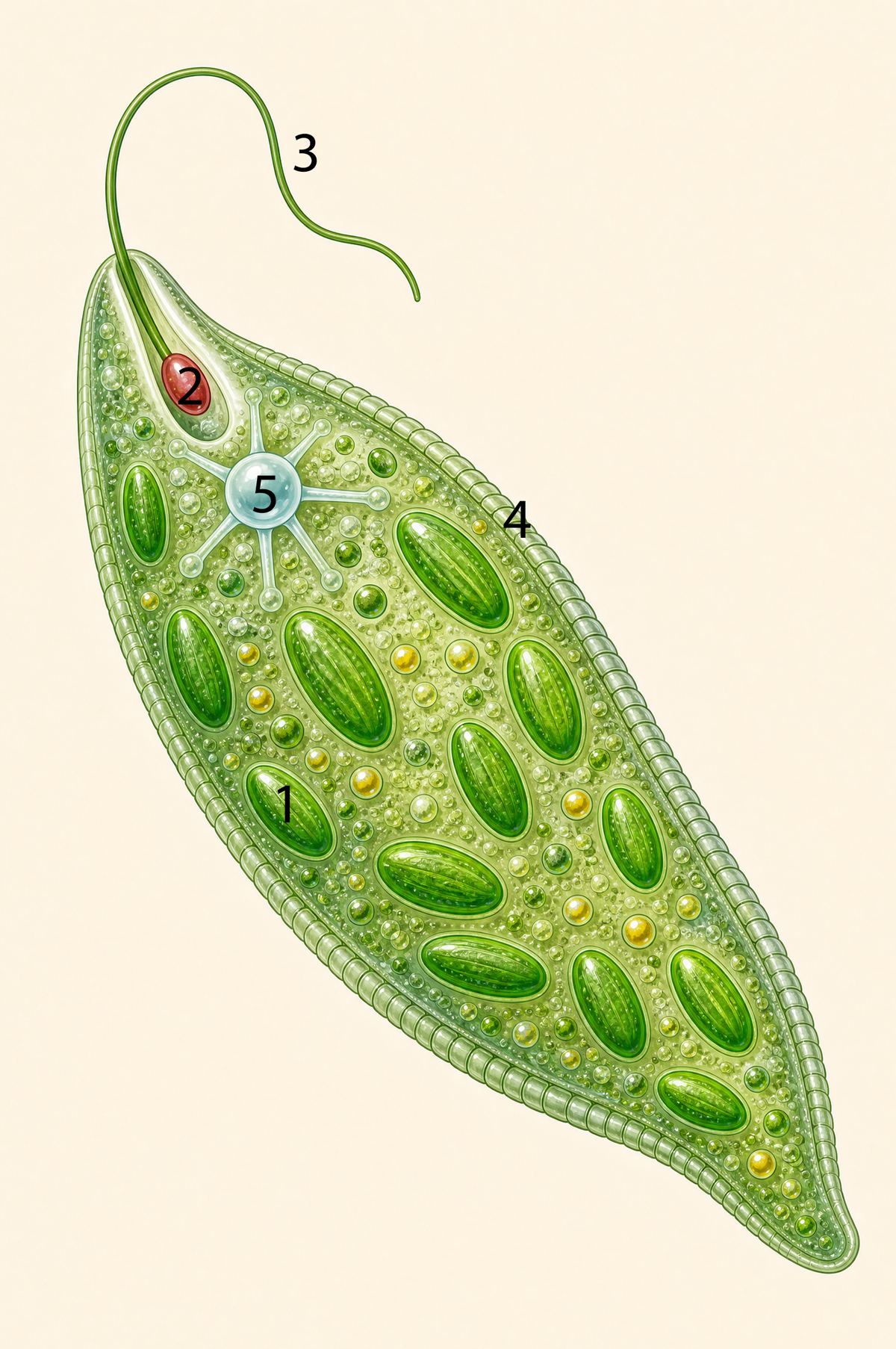
Euglena
Flagellum (single long whip-like structure) for swimming. Eyespot detects light direction. Chloroplasts: photosynthesizes AND takes in food.
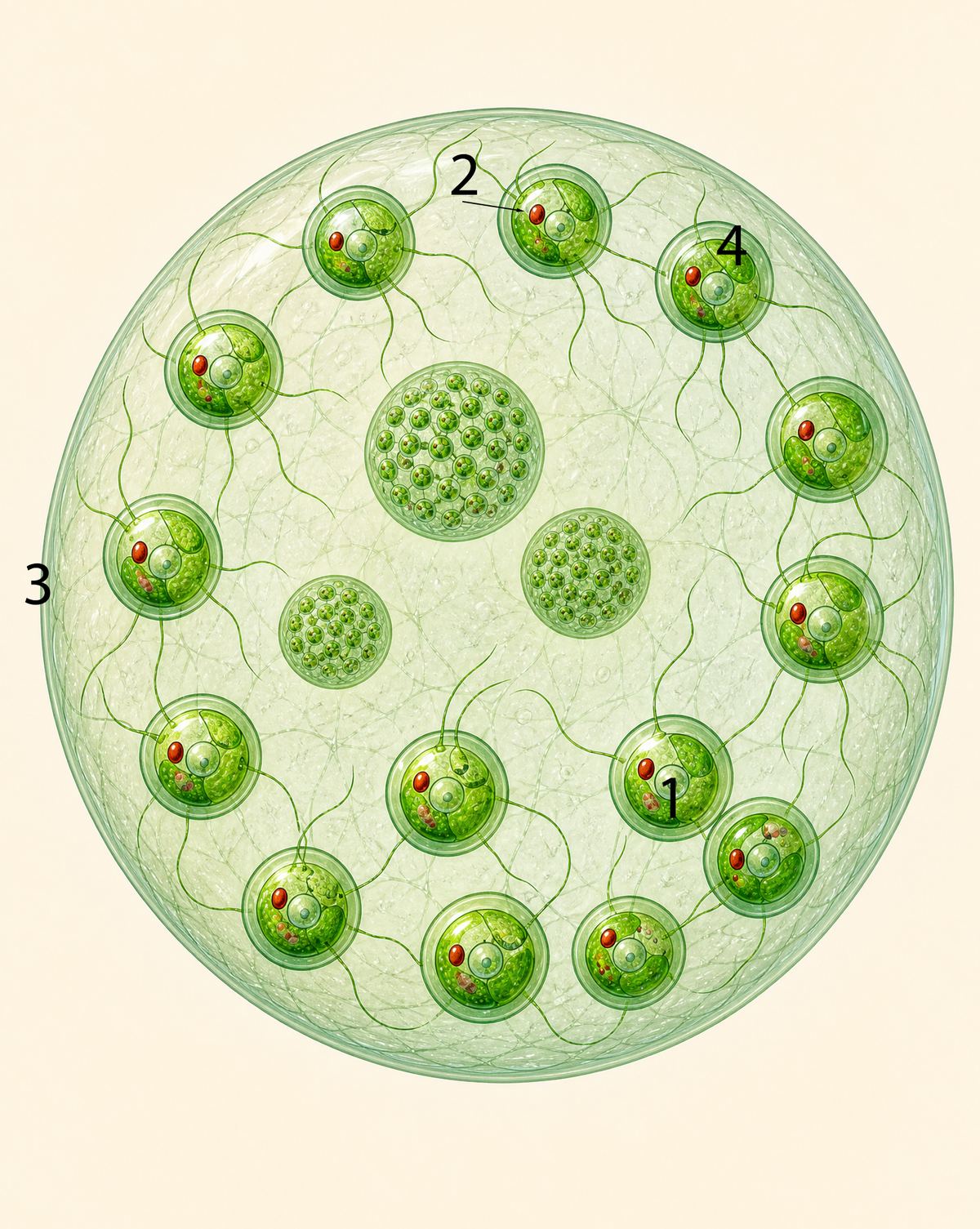
Volvox
A colony of hundreds of individual flagellated cells, each still carrying out the full function list on its own. Daughter colonies form inside and are released, asexual reproduction.
| pseudopod | A temporary, false foot formed when a cell like Amoeba extends part of its own body to move or feed. |
| phagocytosis | The process by which a cell surrounds and engulfs food, the way an Amoeba flows around a smaller organism and seals it inside. |
| cilia | Many short, hair-like structures on a cell, such as Paramecium, that beat together for fast, controlled movement. |
| flagellum | A single long, whip-like structure a cell, such as Euglena, uses to swim. |
| eyespot | A light-sensitive structure near the front of Euglena that detects the direction light is coming from, letting the cell respond by swimming toward it. |
| contractile vacuole | A structure in Amoeba and Paramecium that pumps out excess water to manage the cell's water balance. |
Try it: Which of the four organisms can both photosynthesize and take in food?
Try it: Which structure lets Paramecium move quickly and in a coordinated way?
Try it: An Amoeba is observed engulfing a smaller organism by flowing around it completely. Name the structure and the process.
Try it: Both Amoeba and Paramecium have a contractile vacuole. What job does it do in both, and why do they need it at all?
Cell Organelles & Cell Types
| Organelle | Function |
|---|---|
| Cell membrane | Controls what enters and exits the cell |
| Cell wall | Structure and support; plant and bacterial cells only, not animal cells or any of the four protists above |
| Nucleus | Holds genetic information, directs the cell; absent in bacterial cells |
| Mitochondria | Release energy from food; absent in bacterial cells |
| Chloroplasts | Make food using light; among the four organisms above, only Euglena and Volvox have them |
| Vacuoles | Store materials and manage water; the contractile vacuole is a specific water-balance example |
Plant cell
- Nucleus
- Cell wall
- Chloroplasts
- Mitochondria
Animal cell
- Nucleus
- Mitochondria
- No wall
- No chloroplasts
Bacterial cell
- No nucleus
- No mitochondria
- Has a cell wall (different kind)
Try it: A cell has no nucleus and no mitochondria. What type of cell is it?
Try it: A cell has a nucleus, mitochondria, a cell wall, and chloroplasts. Plant, animal, or bacterial?
Try it: Does Euglena, one of this unit's four protists, have a cell wall?
Microscope Skills
| total magnification | Eyepiece power × objective lens power. |
| start on low power | Always, it's easier to find the specimen with a wider field of view before switching to higher power. |
| wet mount order | Specimen and a drop of water on the slide first, then lower the coverslip at an angle (not dropped flat), to avoid trapping air bubbles. |
| identification | Name a specific visible structure to justify an ID, not just a general impression of shape. One field of view is not enough to finalize an identification. |
Asexual vs. Sexual Reproduction
| asexual reproduction | One parent, offspring genetically identical to it. Example: a Volvox daughter colony. |
| sexual reproduction | Two parents, offspring with genetic variation, a new combination of both parents' genetic information. |
| mutation | A rare copying error that can produce variation even with only one parent (asexual reproduction). |
Try it: A Volvox daughter colony forms inside its parent and is released, genetically identical. Asexual or sexual?
Try it: If asexual reproduction produces identical offspring, how can two Volvox colonies ever end up genetically different from each other?
Start here: videos + interactive
Also on the site
[email protected] · (704) 574-9605