Science 6
Unit 1 Study Guide: Atoms, Elements & States of Matter
Test: Friday, September 4, 2026 · Atoms/elements, thermal energy/phase changes, properties of matter.
This page is for studying, it is not the test and nothing on it is graded. Content matches exactly what was reviewed in class; the practice questions below are new, written to match, not copies of any quiz.
Do these two first
Kris asked for this test to run heavy on thermal energy vocabulary. The Thermal Energy lab and the three Generation Genius videos below are the fastest way to lock that section in before Thursday.
Thermal Energy lab →
Atoms & Elements
| atom | The smallest particle of matter that still keeps that substance's identity. |
| element | A pure substance made of only one type of atom. |
| periodic table | The organized catalog of every known element, one box per element, ordered by atomic number. |
| chemical symbol | The one- or two-letter abbreviation for an element, e.g. Cu (copper), Fe (iron), Al (aluminum), S (sulfur). |
Key idea
If you break a sample of an element in half, it's still the same element, every atom in it is identical to before. What makes one element different from another is the atom itself, not how much of it you have.
Periodic table reference
Try it: You cut a bar of pure copper in half. Is each half still copper? Why?
Yes. Every copper atom in each half is still a copper atom, it's still one type of atom, so it's still the element copper. Cutting a sample only changes how much of it there is, it never changes what kind of atom it's made of, and atom type is the entire definition of an element.
Try it: Using the table above, what element does the symbol "Fe" represent, and where is it (metal, metalloid, or nonmetal)?
Iron. It sits in the shaded "metal" region of the table (the transition metals block), not on the staircase and not to its right, so it is a metal, not a metalloid or nonmetal.
Try it: True or false: every box on the periodic table is a mixture of several elements.
False. Every box represents exactly one element, one type of atom. A mixture would combine two or more different substances; that's not what the periodic table's boxes show.
Thermal Energy & Phase Changes
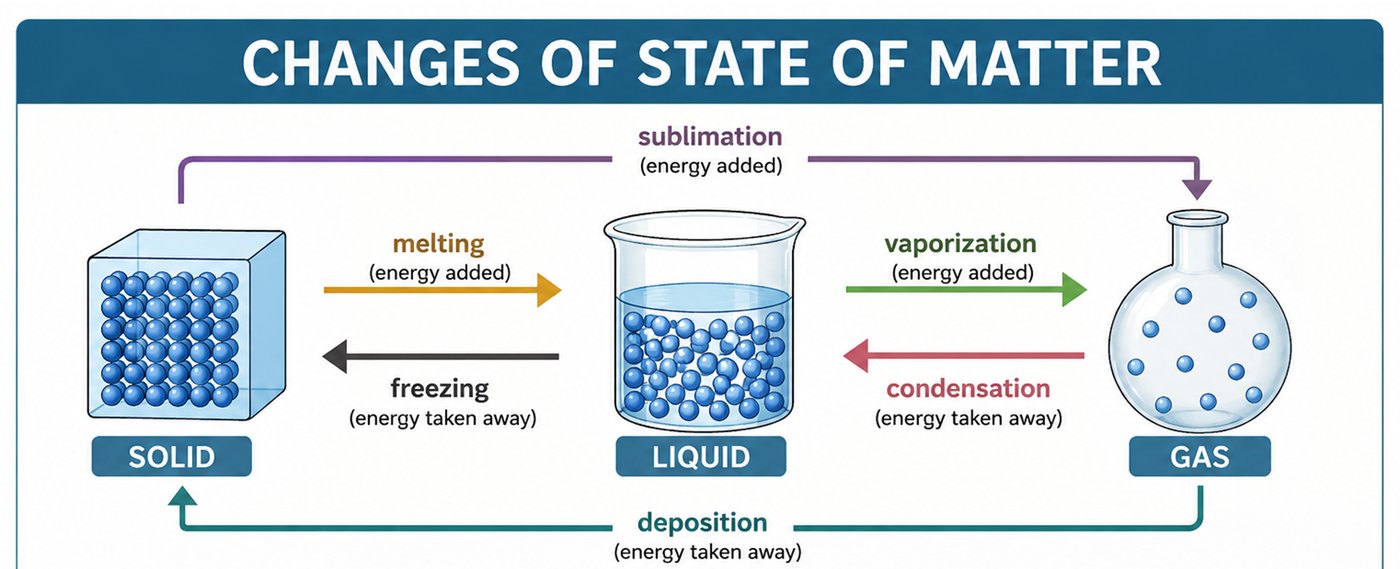
| Process | From | To | Energy |
|---|---|---|---|
| Melting | Solid | Liquid | Added |
| Freezing | Liquid | Solid | Removed |
| Vaporization | Liquid | Gas | Added |
| Condensation | Gas | Liquid | Removed |
| Sublimation | Solid | Gas | Added |
| Deposition | Gas | Solid | Removed |
| thermal energy | The total energy of all the moving particles in a substance; adding thermal energy makes particles move faster and spread farther apart. Not the same as temperature: thermal energy depends on how much substance there is, temperature does not. |
| temperature | A measure of the average kinetic energy of the particles in a substance, not a measure of how much of the substance there is. |
| kinetic energy | The energy an object or particle has because it is moving; faster-moving particles have more kinetic energy. |
| heat | The transfer of thermal energy from a warmer object or substance to a cooler one; heat is energy moving, not a substance stored inside something. |
| solid | A state of matter in which particles are packed in a fixed arrangement and only vibrate in place, giving the substance a definite shape and definite volume. |
| liquid | A state of matter in which particles stay close together but can slide past one another, giving the substance a definite volume but no definite shape of its own. |
| gas | A state of matter in which particles are far apart and move rapidly in every direction, so the substance has no definite shape or volume and expands to fill its container. |
| water vapor | The gas state of water. Water vapor itself is invisible, unlike the visible mist people sometimes call steam. |
| condensation | The phase change in which a gas loses thermal energy and becomes a liquid, for example water vapor becoming the liquid droplets of dew or fog. |
Common mistake
Crystallization is related to freezing, not a separate idea, it's a solid forming an orderly, repeating pattern as thermal energy is lost. And a substance's temperature does not change while it is boiling, even though thermal energy is still being added, the energy is going into changing state, not raising temperature.
Watch these two before you get to the practice below
Thermal Energy lab, driving real substances through all six phase changes, and
Intro to Thermal Energy (Generation Genius) both cover this exact vocabulary set.
Try it: Which phase change is water vapor turning into liquid dew, and is energy added or removed?
Condensation, gas to liquid, energy is removed. The water vapor particles slow down and move close enough together to form a liquid; the water molecules themselves do not change, only their spacing and motion do.
Try it: Dry ice (solid CO₂) turns straight into gas without melting first. What is this called?
Sublimation, solid straight to gas, energy is added. No puddle ever forms because the CO₂ skips the liquid state entirely; the particles at the surface gain enough thermal energy to break free directly into the gas state.
Try it: A pot of water is boiling on the stove. The burner is still on, adding thermal energy the whole time. Why doesn't the water's temperature keep rising past 100°C?
Because at the boiling point, added thermal energy goes into breaking particles free into the gas state (vaporization) rather than speeding the remaining liquid particles up further. Temperature measures average particle speed, and that speed briefly stops increasing while the state itself is changing.
Try it: What is the difference between thermal energy and heat?
Thermal energy is the total motion energy already inside a substance, a property the substance has. Heat is thermal energy actually moving from a warmer place to a cooler one, something that happens between two things. A hot cup of coffee has thermal energy sitting in it right now; heat is what happens when that energy transfers into your hand.
Properties of Matter
| density | How much mass is packed into a given volume (mass ÷ volume). Amount-independent: a small chip and a large block of the same pure substance have the same density. |
| melting point | The temperature at which a substance turns from solid to liquid. The same for a small piece or a large piece of the same substance. |
| boiling point | The temperature at which a substance turns from liquid to gas. Also the same regardless of sample size. |
| solubility | How much of a substance can dissolve into another substance (usually water) at a given temperature; a property of the substance, not of how much you started with. |
| mass | The amount of matter in an object. Doubles if you have twice as much material. |
| volume | The amount of space an object takes up. Also doubles if you have twice as much material. |
| weight | The force of gravity pulling on an object's mass. Changes with sample size the same way mass does. |
Amount-independent
- Density
- Melting point
- Boiling point
- Solubility
Amount-dependent
- Mass
- Volume
- Weight
Why ice floats
Ice floats because it is less dense than liquid water, not because it is lighter. The same mass of water takes up more space as a solid. Density and weight are not the same idea, that's exactly this distinction.
Density reference table
| Sample | Density | Accept within |
|---|---|---|
| Aluminum | 2.70 g/cm³ | ±0.20 |
| Iron | 7.87 g/cm³ | ±0.30 |
| Copper | 8.96 g/cm³ | ±0.30 |
| Zinc | 7.14 g/cm³ | ±0.30 |
| Liquid water | 1.00 g/mL | ±0.05 |
| Ice | 0.92 g/mL | ±0.05 |
A lab-measured density will not land exactly on these values; anything inside the "accept within" range is a correct match, not measurement error.
Try it: Does the melting point of a substance change if you have twice as much of it?
No. Melting point is amount-independent: it's a property of what the substance is made of, not how much of it is sitting on the table. A tiny shaving of iron and a full iron block both start melting at exactly the same temperature.
Try it: You have two blocks of the same metal, one twice the size of the other. Which properties differ between them?
Mass, volume, and weight differ (amount-dependent, they scale with how much material there is). Density, melting point, boiling point, and solubility are the same for both (amount-independent, they depend only on what the substance is).
Try it: A sample has a mass of 17.9 g and a volume of 2.0 cm³. Using the density table above, what is it likely made of?
Density = mass ÷ volume = 17.9 ÷ 2.0 = 8.95 g/cm³, which matches copper (8.96) within the accepted range. It is not iron, aluminum, or zinc, none of those densities are close.
Try it: A raft of ice the size of a car floats on a lake, while a single small pebble sinks. Does this contradict "ice is less dense than water"?
No. Floating depends on density, not on total size or weight. The huge ice raft floats because ice itself (0.92 g/mL) is less dense than water (1.00 g/mL), no matter how big the piece is. The pebble sinks because rock is a completely different, denser substance, this has nothing to do with the ice comparison.
Start here: lab + videos
Thermal Energy lab · drive 20 real substances through all six phase changes, this is the single best way to drill the Topic B vocabulary above
Video: Intro to Thermal Energy (Generation Genius) · covers thermal energy, temperature, and heat back to back
Video: Atoms & Molecules (Generation Genius, atoms/elements portion)
Video: Properties of Elements (Generation Genius)
Also on the site
Kris Tyte, Math & Science 7 · East Voyager Academy of Charlotte
[email protected] · (704) 574-9605
[email protected] · (704) 574-9605