 USA Web School
Heredity - Vocabulary
Grade 7 Science: Inheritance, Dominance, Variation, and Mutation
Learning Objectives
Define and correctly use key heredity vocabulary (gene, allele, trait, genotype, phenotype).
Explain how genes on chromosomes provide instructions that influence traits.
Use a Punnett square to predict possible offspring genotypes and phenotypes for a single trait.
Describe how sexual reproduction and mutations create genetic variation in populations.
Overview
~2 minutesHeredity Vocabulary
This learning object is a reference you can use like a mini-dictionary. Each term has:
- a concise definition
• a short scientific explanation with an example
• a diagram or image to anchor the idea visually
Focus: heredity (inheritance and variation), dominant and recessive traits, genetic variation, and mutation.
Vocabulary terms in this object
Heredity
Trait
DNA (deoxyribonucleic acid)
Chromosome
Gene
Allele
Genotype
Phenotype
Dominant allele
Recessive allele
Homozygous
Heterozygous
Punnett square
Probability (genetics)
Sexual reproduction
Asexual reproduction
Genetic variation
Mutation
Heredity
~0.8 minutesDefinition: The passing of genetic information from parents to offspring.
Heredity is about how information is passed from one generation to the next.
- In most organisms, offspring get one set of chromosomes (and alleles) from each parent.
• Because alleles can be different, siblings can look different even with the same parents.
Example: If both parents carry an allele for attached earlobes, some children may have attached earlobes and some may not, depending on which alleles they inherit.
Trait
~0.8 minutesDefinition: A characteristic of an organism that can be observed or measured.
A trait is a characteristic you can describe, measure, or observe.
Traits can be:
• physical (eye color, leaf shape, fur pattern)
• behavioral (some animal behaviors have a genetic component)
• internal (blood type)
Important: Traits are influenced by genes, but many traits are also influenced by environment (nutrition, temperature, sunlight, and disease).
DNA (deoxyribonucleic acid)
~0.8 minutesDefinition: The molecule that stores genetic instructions in cells.
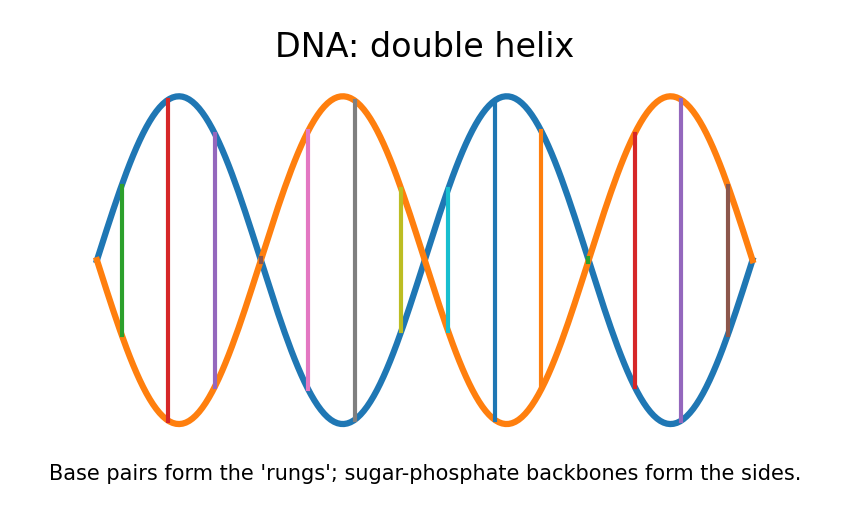
DNA is the molecule that stores instructions used by cells.
- DNA is organized into chromosomes.
• Sections of DNA are called genes.
• The order of DNA bases is like a code. Cells use this code to make proteins.
• Proteins help build structures and carry out jobs in cells, which can affect traits.
Key idea: Changing DNA can change a gene, which can change a protein, which can change a trait.
Chromosome
~0.8 minutesDefinition: A packaged structure of DNA (and proteins) that carries many genes.
A chromosome is DNA packaged tightly so it can fit in the cell nucleus and be moved safely when cells divide.
- Each chromosome contains many genes.
• In many organisms, chromosomes come in pairs, one from each parent.
• A gene's position on a chromosome is called its locus (LOH-kus).
Big picture: Chromosomes are the "containers" that carry DNA and genes from parent to offspring.
Gene
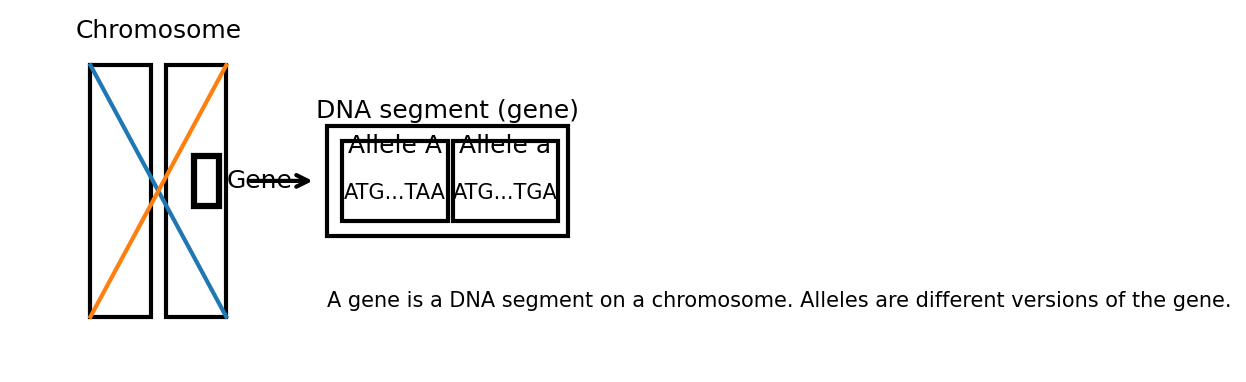
~0.8 minutesDefinition: A segment of DNA on a chromosome that provides instructions for a trait.
A gene is a specific segment of DNA that carries instructions.
- Different genes influence different traits.
• Many genes work together to produce complex traits (like height).
• A gene often influences a trait by affecting a protein that the cell makes.
Example: A gene can influence whether a plant makes a pigment protein that makes flowers look purple.
Allele
~0.8 minutesDefinition: A different version of the same gene.
An allele is a version of a gene.
- Alleles can differ by small DNA changes.
• Different alleles can lead to different trait outcomes.
• In diploid organisms, you usually have two alleles for a gene, one inherited from each parent.
Example: A flower-color gene might have an allele that makes purple pigment and an allele that makes little or no pigment.
Genotype
~0.8 minutesDefinition: The allele combination an organism has for a gene (example: Aa).
Genotype means the alleles an organism has.
- We often write alleles as letters: A, a.
• Example genotypes: AA, Aa, aa.
• Genotype is not always visible, but it helps predict phenotype.
In a simple dominant/recessive model:
• AA and Aa can produce the same phenotype if A is dominant.
Phenotype
~0.8 minutesDefinition: The observable trait produced by genotype and environment (example: purple flowers).
Phenotype is what you can observe.
- Phenotype includes appearance and measurable traits (such as height).
• Phenotype depends on genotype AND environment.
• Two organisms can have the same phenotype but different genotypes (example: AA and Aa can both show a dominant trait).
Example: A plant may have the genotype for tall growth, but poor nutrition can reduce its actual height.
Dominant allele
~0.8 minutesDefinition: An allele that is expressed in the phenotype when at least one copy is present.
A dominant allele is expressed in the phenotype when at least one copy is present.
- If A is dominant, then AA and Aa usually show the dominant phenotype.
• Dominance is about how alleles behave in a heterozygote, not about which allele is "better."
Example: If A codes for pigment, a single A allele may produce enough pigment for a purple flower.
Recessive allele
~0.8 minutesDefinition: An allele that is expressed only when two copies are present.
A recessive allele is expressed only when two copies are present.
- If a is recessive, then aa shows the recessive phenotype.
• A heterozygote (Aa) can carry a recessive allele without showing the recessive trait.
Example: If a results in little pigment, a flower may be white only when genotype is aa.
Homozygous
~0.8 minutesDefinition: Having two identical alleles for a gene (AA or aa).
Homozygous means both alleles are the same.
- Homozygous dominant: AA
• Homozygous recessive: aa
In simple models, homozygous genotypes are easier to predict because there is no allele interaction in a heterozygote.
Heterozygous
~0.8 minutesDefinition: Having two different alleles for a gene (Aa).
Heterozygous means the two alleles are different (example: Aa).
- In a dominant/recessive pattern, the dominant allele usually determines the phenotype.
• Heterozygous individuals can be carriers of a recessive allele.
Key idea: Many inheritance patterns are more complex than simple dominance, but heterozygous still means "two different alleles."
Punnett square
~0.8 minutesDefinition: A model used to predict possible genotypes of offspring from parent genotypes.
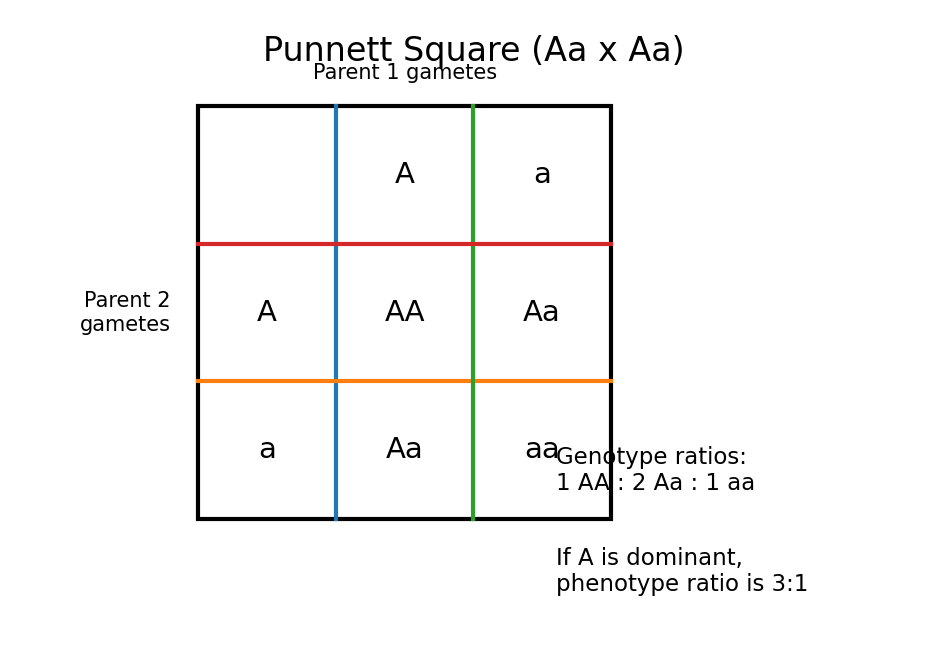
A Punnett square is a model used to predict possible allele combinations in offspring.
How it works: 1. Put one parent's possible gamete alleles across the top. 2. Put the other parent's possible gamete alleles down the side. 3. Fill in the boxes to show possible offspring genotypes.
Example: Aa x Aa produces AA, Aa, Aa, aa (a 1:2:1 genotype ratio).
Probability (genetics)
~0.8 minutesDefinition: A way to express the chance of a genetic outcome (example: 1 out of 4).
Probability describes how likely an outcome is.
- In genetics, probability is used to predict the chance of each genotype or phenotype.
• A Punnett square counts outcomes, then you convert counts to fractions or percentages.
Example: In Aa x Aa, the probability of aa is 1 out of 4 (1/4), which is 25%. Important: Probability predicts chance, not a guarantee for any single child.
Sexual reproduction
~0.8 minutesDefinition: Reproduction using two parents that creates offspring with genetic variation.
Sexual reproduction combines genetic information from two parents.
- Each parent produces gametes (sex cells) that carry one allele for each gene.
• Fertilization combines two gametes into a zygote.
• This mixing creates new allele combinations, which increases genetic variation.
Result: Sexual reproduction is a major reason why offspring are not identical to their parents.
Asexual reproduction
~0.8 minutesDefinition: Reproduction using one parent that usually creates genetically identical offspring.
Asexual reproduction uses one parent to produce offspring.
- Offspring usually have the same genetic information as the parent (clones).
• Examples: binary fission (bacteria), budding (some yeast and hydra), runners (some plants).
• Differences can still occur if mutations happen.
Result: Asexual reproduction is fast and efficient, but it usually produces less genetic variation.
Genetic variation
~0.8 minutesDefinition: Differences in genes and alleles among individuals in a population.
Genetic variation is the presence of differences in alleles and genes among individuals.
Main sources of variation:
• different alleles already present in a population
• new combinations of alleles through sexual reproduction
• new alleles formed by mutation
Why it matters: Variation gives populations the raw material for natural selection. If the environment changes, some variants may survive and reproduce more successfully.
Mutation
~0.8 minutesDefinition: A change in DNA that can create new alleles.
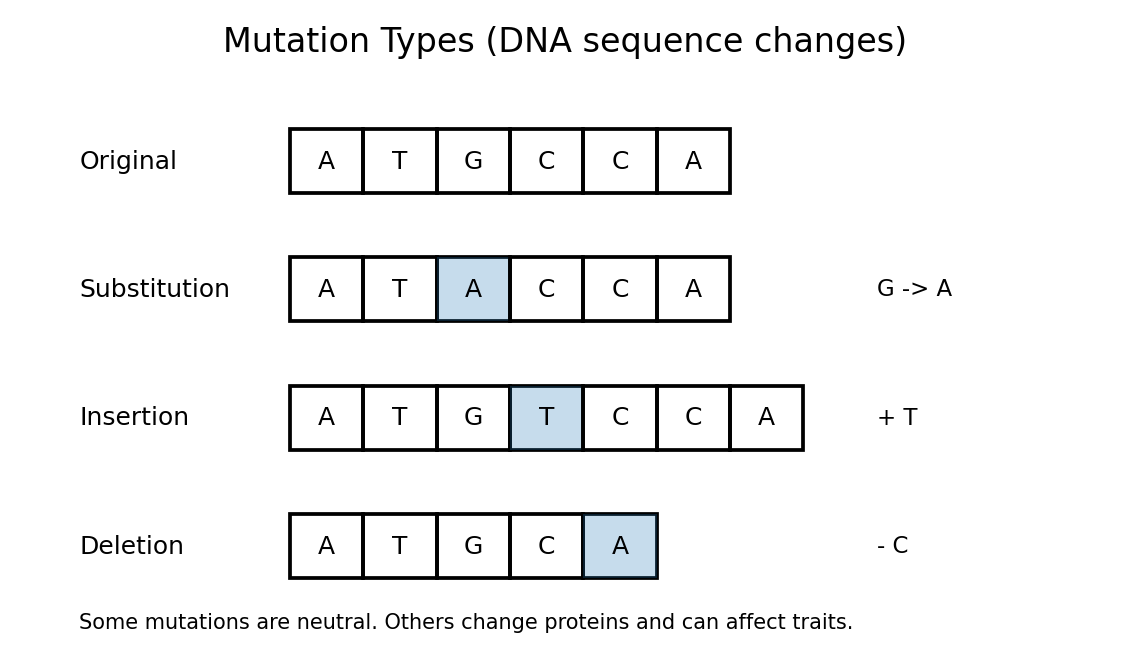
A mutation is a change in DNA sequence.
Types of mutations include:
• substitution (one base replaced by another)
• insertion (extra base added)
• deletion (base removed)
Mutations can be:
• neutral (no noticeable effect)
• harmful (reduces survival or reproduction)
• beneficial (improves survival or reproduction)
Key idea: Mutations create new alleles, which can increase genetic variation.
Practice and check understanding
~12 minutesPractice
1. Complete the matching activity. 2. Make flashcards for terms you still mix up. 3. Explain the Aa x Aa example using the words genotype, phenotype, dominant, and recessive.
Match each genetics term to its correct definition.
A student has the genotype Aa for a trait where A is dominant. Which statement is most accurate?
Which processes can increase genetic variation in a population? (Select all that apply)
Select all that apply.