 USA Web School
Eukaryotic Cell Biology — Study Guide
A condensed review of organelles, ATP production, and photosynthesis
Learning Objectives
Recall the structure and function of major organelles in eukaryotic cells.
Recall the three stages, locations, and overall equation of cellular respiration.
Recall the two stages, locations, and overall equation of photosynthesis.
Compare and contrast cellular respiration and photosynthesis.
How to use this guide
~1 minutesEukaryotic Cell Biology — Study Guide
This is a condensed review of the main Eukaryotic Cell Biology lesson. Use it to refresh on the essentials before a quiz, test, or class discussion.
You'll get the most out of this study guide if you have already worked through the main lesson. This guide is for review — not for first-time learning.
For each section: read the summary, study the diagram, and try the quick checks at the end.
Reference intro
~1 minutesSection 1: Reference Infographics
Spend 2-3 minutes studying each infographic below. Cover the labels with your hand and try to name each organelle. Then check yourself.
Animal cell
~2 minutes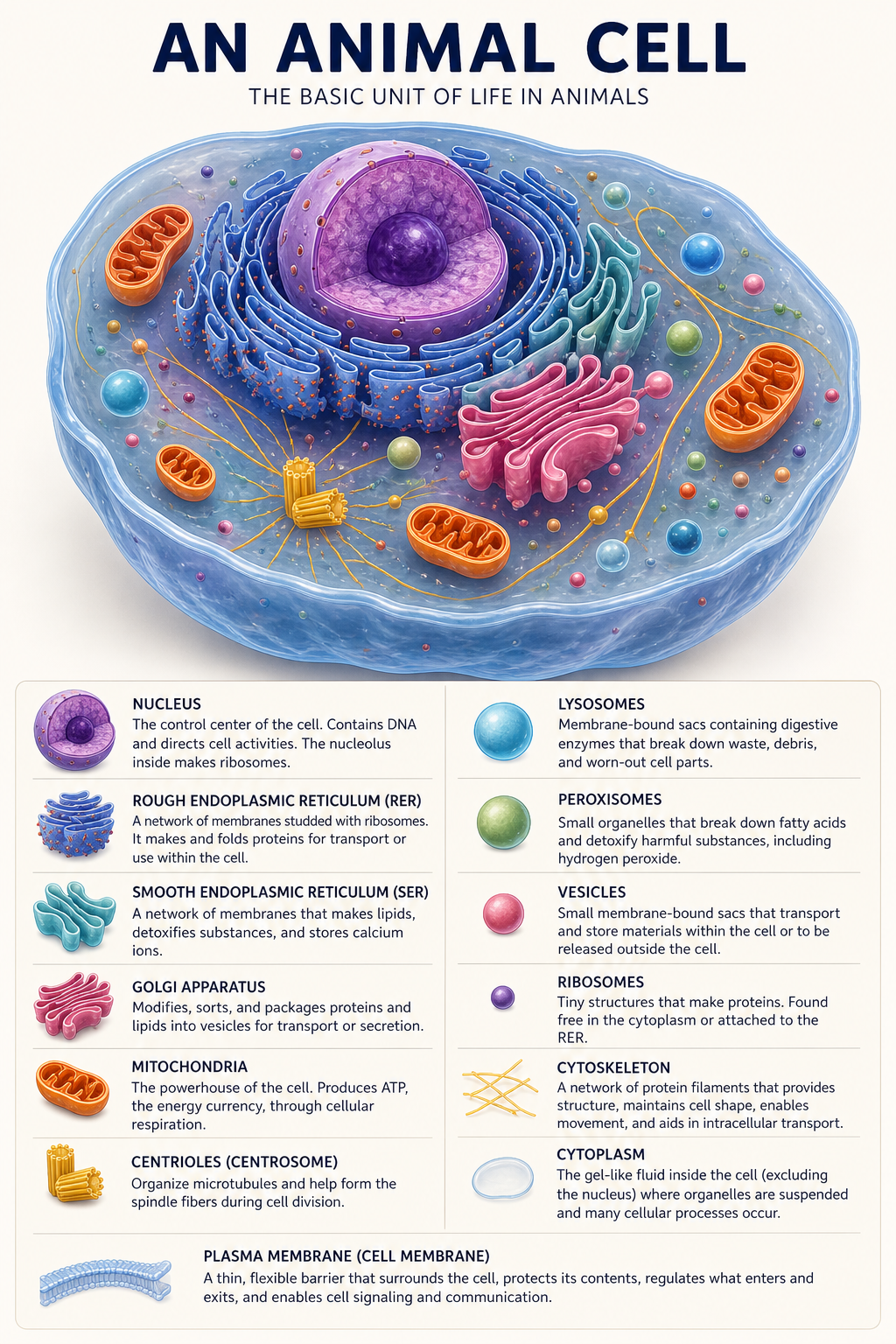
Plant cell
~2 minutes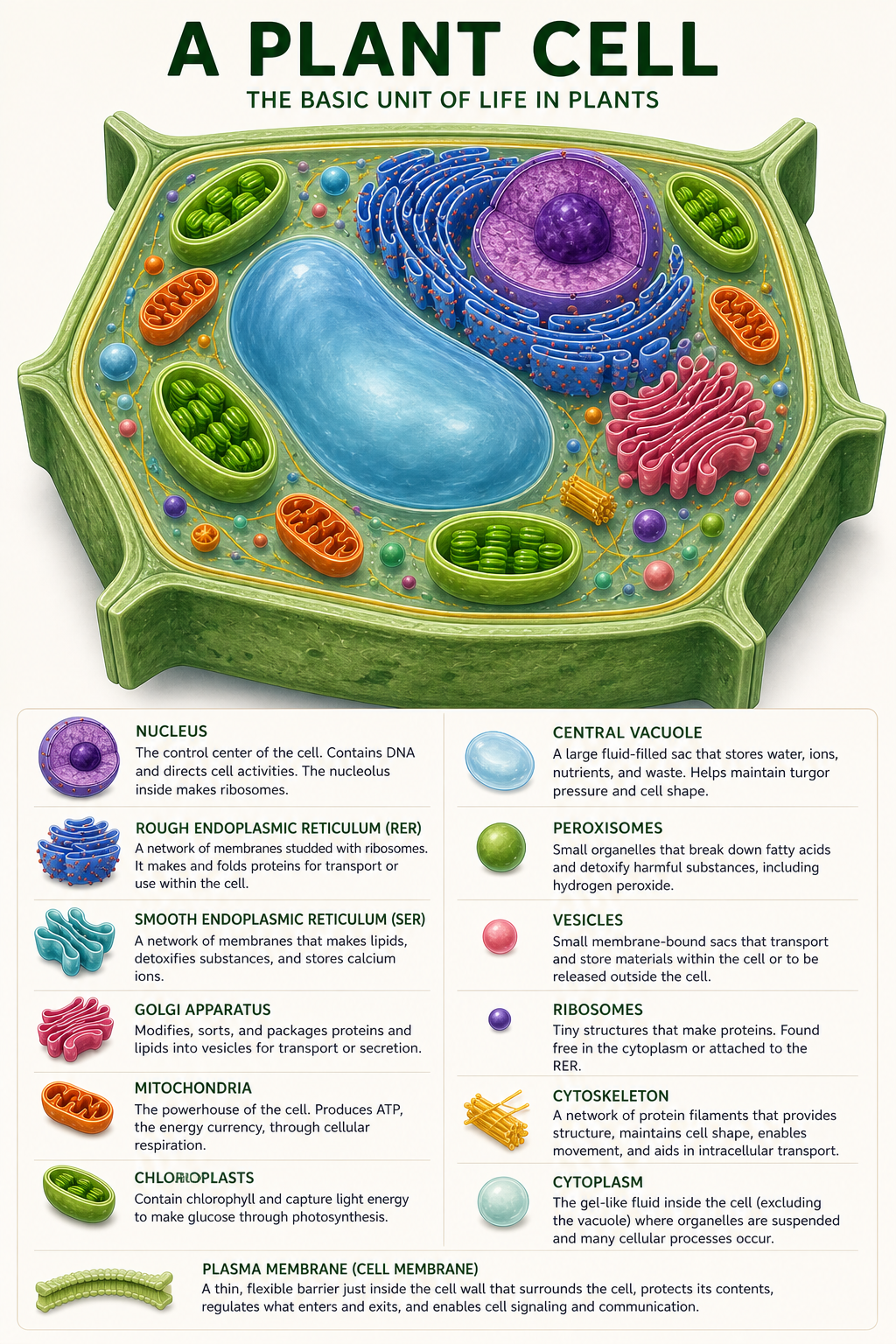
Section intro
~1 minutesSection 2: Organelle Cheat Sheet
Quick reference for every major organelle. Each one has a single sentence that tells you what it does.
Boundaries
~1 minutesPlasma membrane — controls what enters and exits the cell (in BOTH plant and animal cells) Cell wall — rigid outer layer made of cellulose; gives plants their shape (PLANT only)
Information hub
~1 minutesNucleus — control center; holds the DNA; directs the cell's activities Nucleolus — small dark spot inside the nucleus; the ribosome factory Ribosomes — tiny machines that build proteins by reading mRNA
Endomembrane
~2 minutesRough ER — covered with ribosomes; builds and folds proteins Smooth ER — no ribosomes; makes lipids and detoxifies substances Golgi apparatus — stack of flat sacs; modifies, sorts, and packages proteins Vesicles — tiny membrane bubbles; transport materials between organelles Lysosomes — sacs of digestive enzymes; break down waste (animal cells) Peroxisomes — break down fatty acids and detoxify (both cell types)
Energy organelles
~1 minutesMitochondria — the powerhouse; produce ATP through cellular respiration (BOTH cell types — yes, plants too!) Chloroplasts — capture sunlight to make glucose through photosynthesis (PLANT only)
Support structures
~1 minutesCentral vacuole — large fluid-filled sac; stores water and maintains turgor pressure (PLANT only) Cytoskeleton — protein fibers; the cell's "bones and highways" Centrioles — organize spindle fibers during cell division (mostly ANIMAL only) Cytoplasm — gel-like fluid that fills the cell
Quick check
~1 minutesWhich organelle is found in plant cells but NOT in animal cells?
Organelle match
~1 minutesMatch each organelle to its primary function:
Cellular respiration intro
~1 minutesSection 3: Cellular Respiration — The Essentials
Cellular respiration is how cells break down glucose to make ATP. Most of it happens inside the mitochondria.
Three-stage flowchart
~2 minutesThe 3 stages
~2 minutesStage 1 — Glycolysis (in the cytoplasm) Glucose → 2 pyruvate; nets 2 ATP; no oxygen needed.
Stage 2 — Krebs Cycle (in the mitochondrial matrix) Pyruvate fully broken down; releases CO2; nets 2 ATP; loads up electron carriers.
Stage 3 — Electron Transport Chain (on the cristae) Uses oxygen; produces ~26 ATP; releases water. This is where most ATP is made!
Total: ~30 ATP per glucose.
The equation
~1 minutesC₆H₁2O₆ + 6 O2 → 6 CO2 + 6 H2O + ~30 ATP
Glucose + oxygen → carbon dioxide + water + ATP
Quick check
~1 minutesWhich stage of cellular respiration produces the MOST ATP?
Where glycolysis happens
~1 minutesWhere in the cell does glycolysis happen?
Equation fill-in
~1 minutesThe overall equation for cellular respiration: glucose + ______ → carbon dioxide + ______ + ATP.
Photosynthesis intro
~1 minutesSection 4: Photosynthesis — The Essentials
Photosynthesis is how plant cells convert sunlight into chemical energy stored in glucose. It happens inside the chloroplasts.
Two-stage flowchart
~2 minutesThe 2 stages
~2 minutesStage 1 — Light Reactions (in the thylakoid membranes) Chlorophyll absorbs sunlight; splits water; releases O2; makes ATP and NADPH.
Stage 2 — Calvin Cycle (in the stroma — the fluid) Uses CO2 from the air, plus ATP and NADPH from the light reactions, to build glucose.
Key fact: the oxygen released by photosynthesis comes from splitting WATER, not carbon dioxide!
The equation
~1 minutes6 CO2 + 6 H2O + light energy → C₆H₁2O₆ + 6 O2
Carbon dioxide + water + light → glucose + oxygen
Light reactions location
~1 minutesWhere do the LIGHT REACTIONS of photosynthesis take place?
Source of oxygen
~1 minutesThe oxygen released by photosynthesis comes from splitting water (H2O).
Equation fill-in
~1 minutesThe overall equation for photosynthesis: carbon dioxide + ______ + light → ______ + oxygen.
Compare intro
~1 minutesSection 5: Photosynthesis vs. Cellular Respiration
The two energy processes work as partners. The products of one are the reactants of the other.
Energy flow diagram
~2 minutesSide-by-side
~2 minutes| Photosynthesis | Cellular Respiration | |
|---|---|---|
| Where | Chloroplasts | Mostly mitochondria |
| Who does it | Plants only | EVERY eukaryotic cell |
| Inputs | CO₂ + H₂O + light | Glucose + O₂ |
| Outputs | Glucose + O₂ | CO₂ + H₂O + ATP |
| Energy | Stores it (builds glucose) | Releases it (makes ATP) |
| When | Daytime only | All the time, day and night |
Energy vs. matter
~1 minutesEnergy ENTERS the system from the sun, gets stored in glucose, and eventually leaves as heat (one-way). Matter (carbon, oxygen, water atoms) RECYCLES between photosynthesis and respiration over and over (cyclical).
Plants do both
~1 minutesPlant cells have BOTH chloroplasts AND mitochondria.
True statement
~1 minutesWhich statement about plants is TRUE?
Process match
~2 minutesMatch each input or output to the right process:
Plant vs animal intro
~1 minutesSection 6: Plant vs. Animal Cell
A side-by-side comparison of the two main eukaryotic cell types you need to know.
Side-by-side diagram
~2 minutesDifferences and shared
~2 minutesPLANT cells uniquely have:
• Cell wall (rigid outer layer, made of cellulose)
• Central vacuole (giant water-storage sac)
• Chloroplasts (for photosynthesis)
ANIMAL cells uniquely have:
• Centrioles (for cell division)
• More prominent lysosomes
Both cell types share: plasma membrane, nucleus, ribosomes, rough ER, smooth ER, Golgi, mitochondria, vesicles, peroxisomes, cytoskeleton, cytoplasm
Cell wall fill-in
~1 minutesThe rigid outer layer of a plant cell, made of cellulose, is called the ______ ______.
Quiz wrap-up
~1 minutesSection 7: Self-Quiz
Twelve quick checks to test your readiness. Try to answer without looking back. If you miss one, the related section above is where to review.