 USA Web School
Eukaryotic Cell Biology: Organelles, ATP, and Photosynthesis
A deep dive into the parts of plant and animal cells, how cells make energy through cellular respiration, and how plants capture sunlight through photosynthesis
Learning Objectives
Identify the major organelles in eukaryotic plant and animal cells and describe the basic function of each.
Explain how organelles work together as systems — for example, how the nucleus, ribosomes, rough ER, Golgi, and vesicles cooperate to produce and ship proteins.
Describe the three stages of cellular respiration (glycolysis, Krebs cycle, electron transport chain), where each takes place, and explain how the process produces ATP from glucose.
Describe the two stages of photosynthesis (light reactions and the Calvin cycle), where each takes place inside the chloroplast, and explain how plants convert light energy into stored chemical energy in glucose.
Compare and contrast cellular respiration and photosynthesis, and explain how they form a complementary cycle of energy and matter through living systems.
Predict the consequences for a cell or whole organism when a specific organelle, energy process, or input (oxygen, glucose, sunlight) is disrupted.
Welcome
~2 minutesEukaryotic Cell Biology
Every living thing on Earth is built from cells. Some are simple — bacteria are single cells with no inner compartments. Others, including you, every plant in your yard, every fish in the ocean, and every mushroom in the forest, are made of eukaryotic cells: complex cells with a true nucleus and lots of specialized inner parts called organelles.
In this lesson you will:
1. Take a guided tour of every major organelle in plant and animal cells 2. Dig into how cells make energy through cellular respiration (the job of the mitochondria) 3. See how plants capture sunlight through photosynthesis (the job of the chloroplasts) 4. Learn how these two processes connect, fueling almost all life on Earth
You will also see two reference infographics — one for the plant cell, one for the animal cell — that you can use as a study guide throughout.
What is a cell?
~1 minutesA cell is the smallest unit of life. Every living thing is made of one or more cells. Inside a eukaryotic cell, work is divided up among different organelles, each shaped to do a specific job. The cell as a whole only works because all of these parts cooperate.
Generic eukaryotic cell
~2 minutesYour study aids
~1 minutesYour Two Reference Infographics
Below are detailed reference images of an animal cell and a plant cell. Each one labels every major organelle and gives a short description of what it does. Bookmark these — you will see them again at the end of the lesson as a study guide.
Animal cell infographic
~2 minutes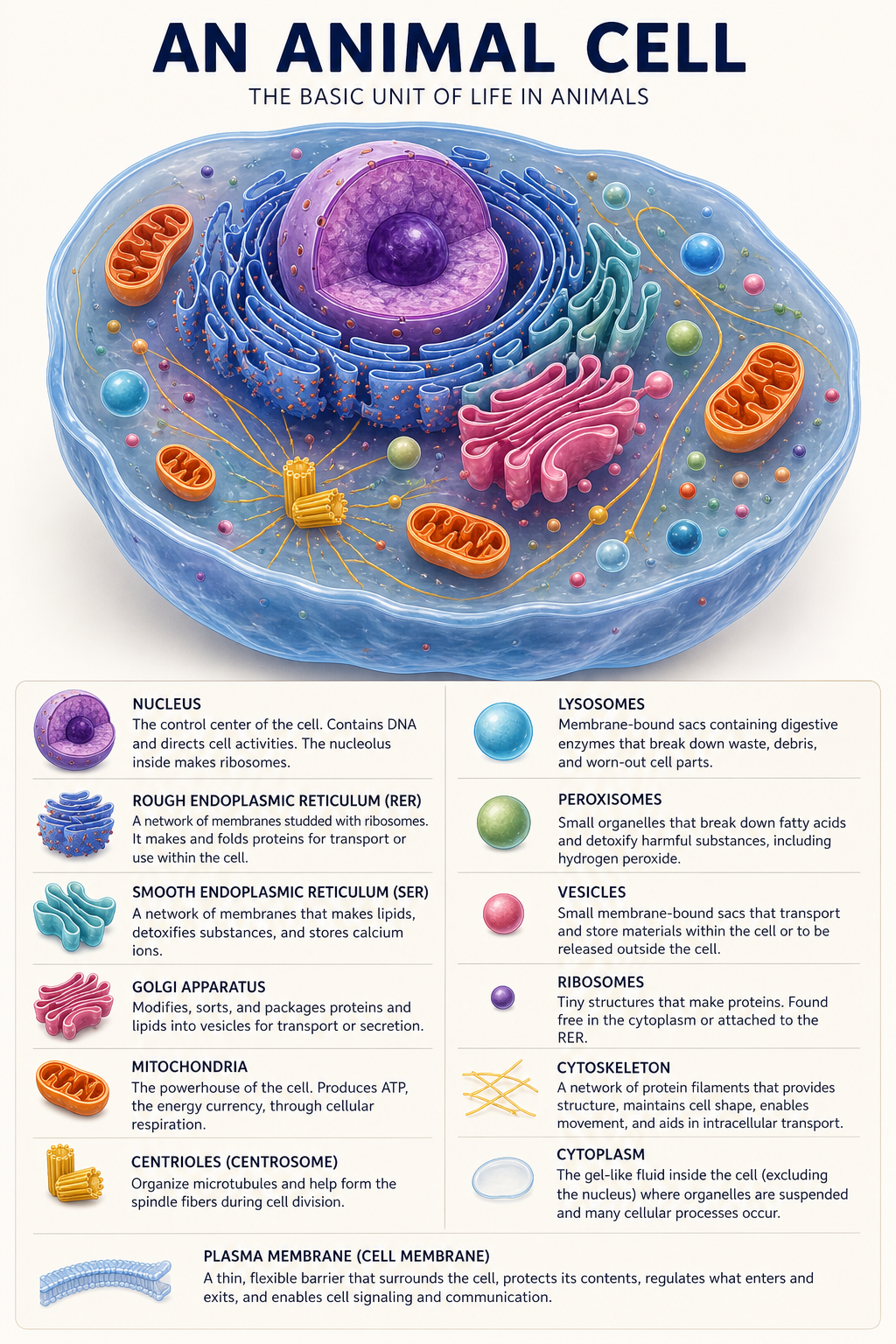
Plant cell infographic
~2 minutes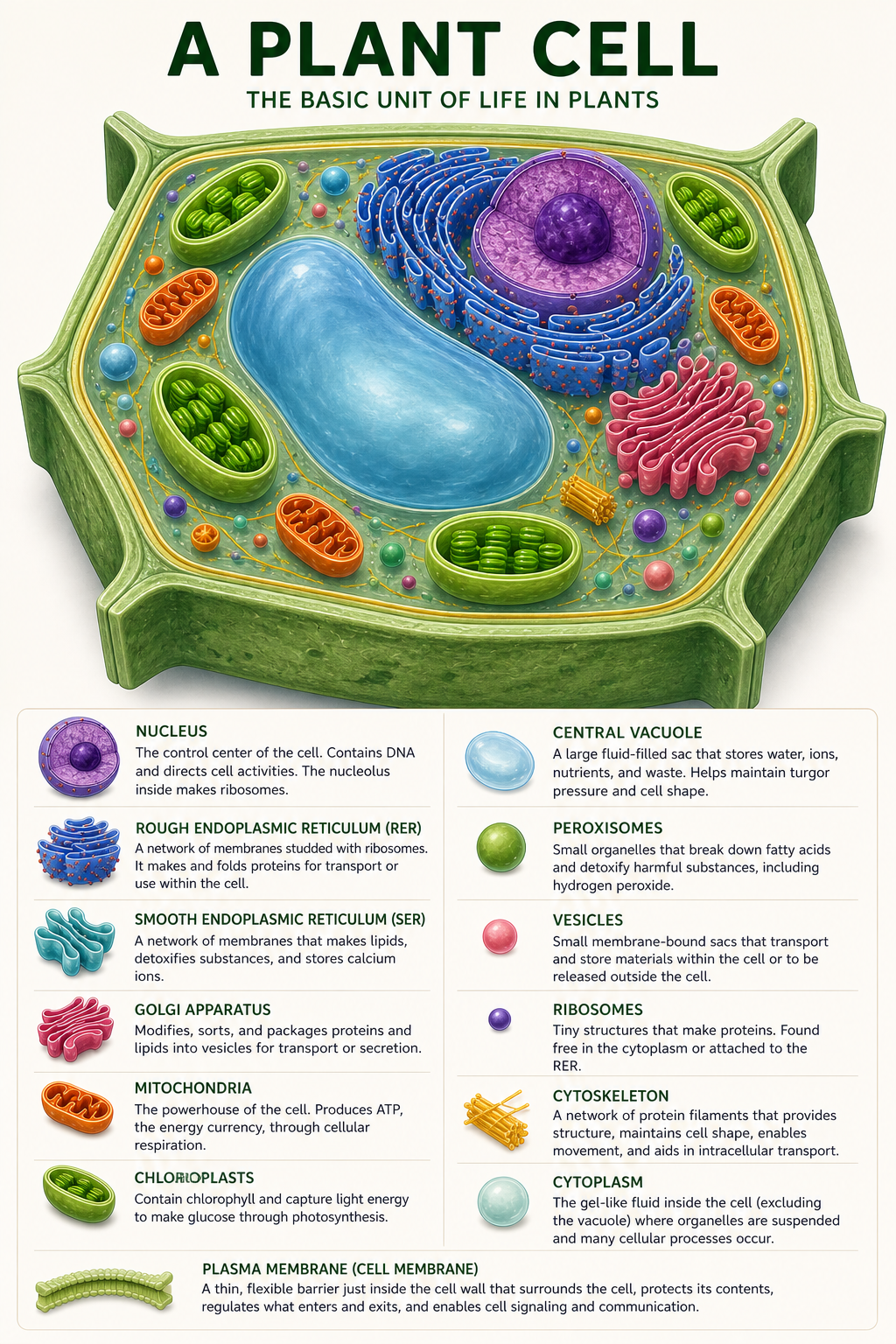
Section intro
~1 minutesSection 1: The Cell's Boundaries
Every cell needs a way to keep its insides separate from its surroundings. Eukaryotic cells use a thin, flexible plasma membrane as their main boundary. Plant cells add a tough outer layer called a cell wall.
Plasma membrane
~3 minutesPlasma Membrane (Cell Membrane)
Found in: every eukaryotic cell (plant and animal)
The plasma membrane is built from a double layer of fatty molecules called a phospholipid bilayer. Proteins are embedded in this layer like floating boats — they act as gates, sensors, and pumps.
Jobs of the plasma membrane:
- Holds the cell together (a flexible boundary, not a rigid one)
• Controls what enters and exits (selective permeability)
• Sends and receives chemical signals from other cells
• Recognizes self vs. non-self (important for immune defense in animals)
The plasma membrane is selectively permeable. That means it lets some things in (like oxygen, water, and nutrients) and keeps other things out (like waste and harmful substances). It can also actively pump materials in or out using protein channels.
Cell wall
~3 minutesCell Wall (Plant Cells Only)
Found in: plant cells only (also fungi and bacteria, but not animals)
Outside the plasma membrane, plant cells have a thick, rigid wall mostly made of cellulose, a tough fiber. The wall acts like a corset around the plant cell.
Jobs of the cell wall:
- Gives plants their shape and stiffness (think of a tree trunk!)
• Protects the cell from damage and predators
• Stops the cell from bursting when it takes in lots of water
• Lets water and small molecules pass through (it isn't a complete barrier)
This is why a tree can stand up tall but you can't — animal cells don't have this rigid outer wall.
Check: cell wall
~1 minutesThe rigid outer layer made of cellulose that surrounds plant cells is called the ______ ______.
Section intro
~1 minutesSection 2: The Information Hub — Nucleus and Ribosomes
Cells need instructions to know what to build. Those instructions are stored in DNA, and the nucleus is where the DNA lives.
Nucleus
~4 minutesNucleus
Found in: every eukaryotic cell (plant and animal)
The nucleus is the control center of the cell. It is wrapped in its own double membrane called the nuclear envelope and contains all of the cell's DNA, organized into thread-like structures called chromatin (which condense into chromosomes when the cell divides).
Jobs of the nucleus:
- Stores the DNA — the master instructions for the cell
• Copies portions of DNA into a working copy called messenger RNA (mRNA)
• Sends mRNA out through small holes called nuclear pores
• Controls when the cell grows and divides
When the cell needs to make a specific protein, the recipe is copied from the DNA into mRNA inside the nucleus. The mRNA exits through nuclear pores and goes to a ribosome to be read.
Nucleolus
~1 minutesNucleolus
Found in: every eukaryotic cell (inside the nucleus)
If you zoom into the nucleus, you'll spot a small, dense, dark spot called the nucleolus. This is the part of the nucleus where ribosomes are built. Ribosome parts are assembled here and then shipped out into the rest of the cell.
You can think of the nucleolus as the cell's "ribosome factory."
Ribosomes
~3 minutesRibosomes
Found in: every eukaryotic cell (and even bacteria!)
Ribosomes are tiny, two-piece machines that read mRNA and snap together amino acids in the right order to make a protein. Cells contain millions of ribosomes — they are the busiest machines in the cell.
Ribosomes come in two locations:
- Free ribosomes float in the cytoplasm and make proteins that will stay inside the cell
• Bound ribosomes are stuck to the rough endoplasmic reticulum (you'll meet this next) and make proteins that will leave the cell or get inserted into membranes
Check: control center
~1 minutesWhich organelle is sometimes called the 'control center' of the cell because it holds the DNA and directs cell activities?
Section intro
~1 minutesSection 3: The Endomembrane System
The endomembrane system is a connected network of organelles that work together to build, package, and ship proteins and lipids. It includes the rough ER, smooth ER, Golgi apparatus, vesicles, lysosomes, and the plasma membrane itself.
Think of it as the cell's combined factory and post office.
Pathway diagram
~2 minutesRough ER
~2 minutesRough Endoplasmic Reticulum (Rough ER)
Found in: every eukaryotic cell
The rough ER is a network of folded membranes connected to the nuclear envelope. It looks "rough" under a microscope because it's covered with thousands of ribosomes.
Jobs of the rough ER:
- Builds proteins (with the help of its attached ribosomes)
• Folds those proteins into the correct 3D shape
• Catches mistakes — misfolded proteins are tagged for destruction
• Packages finished proteins into vesicles for shipping to the Golgi
Smooth ER
~2 minutesSmooth Endoplasmic Reticulum (Smooth ER)
Found in: every eukaryotic cell
The smooth ER is connected to the rough ER but has no ribosomes attached, which is why it looks smooth.
Jobs of the smooth ER:
- Makes lipids (fats), including the ones used to build new membranes
• Detoxifies harmful substances (especially in liver cells, where it breaks down drugs and alcohol)
• Stores calcium ions, which the cell uses for signaling and muscle contraction
Golgi apparatus
~2 minutesGolgi Apparatus
Found in: every eukaryotic cell
The Golgi apparatus looks like a stack of flattened pancakes. It is the cell's shipping and receiving department.
Jobs of the Golgi:
- Receives proteins and lipids in vesicles from the ER
• Modifies them — for example, attaching sugar tags
• Sorts them by destination
• Packages them into new vesicles labeled for where they need to go (out of the cell, to a lysosome, to the plasma membrane, etc.)
Vesicles
~1 minutesVesicles
Found in: every eukaryotic cell
Vesicles are tiny membrane-bound bubbles that bud off from one organelle and merge with another. They are the cell's delivery trucks.
Jobs of vesicles:
- Transport proteins and lipids between organelles
• Carry materials in from outside (endocytosis) or out to the outside (exocytosis)
• Store materials temporarily
Lysosomes & peroxisomes
~1 minutesLysosomes and Peroxisomes
Lysosomes (mostly in animal cells) are membrane sacs full of strong digestive enzymes. They break down worn-out organelles, debris, and food particles. Think of them as the cell's recycling and trash crew.
Peroxisomes (in both animal and plant cells) are smaller sacs that break down fatty acids and detoxify harmful substances, including hydrogen peroxide. They protect the cell from chemical damage.
Both are wrapped in a single membrane to keep their dangerous enzymes safely contained.
Check: protein pathway order
~1 minutesPlace the steps of protein production and shipping in the correct order, starting from the DNA recipe:
Check: Golgi job
~1 minutesWhat is the main job of the Golgi apparatus?
Check: endomembrane match
~1 minutesMatch each part of the endomembrane system to what it does:
Check: short answer
~1 minutesExplain how the rough endoplasmic reticulum, the Golgi apparatus, and vesicles work together as a system. Use specific organelle names in your answer.
Expected length: 50-150 words
Section intro
~1 minutesSection 4: Mitochondria and Cellular Respiration — The Deep Dive
Every living thing needs energy. Cells get their energy by breaking down food (mostly the sugar glucose) in a process called cellular respiration. Most of this work happens inside the mitochondria.
Mitochondrion structure
~3 minutesThe Mitochondrion: Built for Energy Production
Found in: every eukaryotic cell — both animal and plant cells (yes, plant cells have mitochondria too!)
A mitochondrion has a smooth outer membrane and a deeply folded inner membrane. The folds are called cristae. The folds give the inner membrane a huge amount of surface area, which is important because that's where most of the ATP gets made.
Inner spaces:
- Matrix — the fluid space inside the inner membrane
• Intermembrane space — the gap between the two membranes
• Cristae — the folds of the inner membrane
Mitochondria even have their own small loop of DNA — evidence that mitochondria likely came from ancient bacteria that got swallowed by an early eukaryotic cell. We inherit our mitochondria from our biological mother.
What is ATP?
~1 minutesATP (adenosine triphosphate) is the cell's main energy currency. When a cell needs energy to do anything — move, grow, build a protein, contract a muscle — it spends ATP. Cellular respiration's whole job is to MAKE more ATP. Think of ATP like a charged battery and ADP like an empty one.
ATP/ADP cycle
~1 minutesBig picture
~2 minutesCellular Respiration: The Big Picture
Cellular respiration is the process that breaks glucose down step-by-step and uses the released energy to make ATP. It happens in three main stages:
1. Glycolysis — happens in the cytoplasm, splits glucose into two pyruvate molecules, makes a small amount of ATP, and does not require oxygen. 2. Krebs Cycle (also called the citric acid cycle) — happens in the matrix of the mitochondrion, fully breaks pyruvate down, releases CO2, and makes a small amount of ATP plus high-energy electron carriers. 3. Electron Transport Chain (ETC) — happens on the cristae (inner mitochondrial membrane), uses oxygen to make the vast majority of the ATP.
By the time one glucose molecule is fully processed, the cell has produced about 30 ATP in total. Compare that to the 2 ATP from glycolysis alone — the mitochondrion is far more efficient than the cytoplasm.
Three-stage flowchart
~2 minutesWhere each stage happens
~2 minutesStage 1: Glycolysis
~2 minutesStage 1: Glycolysis (Cytoplasm)
Glycolysis means splitting sugar. It is the oldest energy-producing pathway and happens in the cytoplasm, outside the mitochondria.
What happens:
- One molecule of glucose (a 6-carbon sugar) is split into two molecules of pyruvate (3-carbon each)
• The cell uses 2 ATP to start the process but produces 4 ATP, so the net gain is 2 ATP
• High-energy electrons are loaded onto carriers called NADH for use later
Important: glycolysis does not require oxygen. This is why some cells (like fast-twitch muscle cells during a sprint) can keep going briefly even when they run low on oxygen.
Stage 2: Krebs cycle
~2 minutesStage 2: The Krebs Cycle (Matrix)
The two pyruvate molecules from glycolysis travel into the matrix of the mitochondrion. There, they get fully broken down through the Krebs cycle (also called the citric acid cycle, after Hans Krebs who discovered it).
What happens:
- Each pyruvate gets broken apart, releasing carbon dioxide (CO2) as waste
• A small amount of ATP is made (2 ATP per glucose total from this stage)
• A LOT of high-energy electrons are loaded onto NADH and FADH2 carriers — these are the real prize, because they will be used to make most of the ATP in the next stage
The CO2 released here is the same CO2 you breathe out. It travels through your blood to your lungs, then out into the air.
Stage 3: ETC
~2 minutesStage 3: The Electron Transport Chain (Cristae)
This is where most of the ATP gets made. The electron transport chain (ETC) sits on the folded inner membrane (cristae) of the mitochondrion.
What happens:
- NADH and FADH2 drop off their high-energy electrons at the start of the chain
• The electrons get passed down a series of proteins, releasing energy at each step
• That energy is used to pump hydrogen ions across the inner membrane, building up a kind of "battery"
• The hydrogen ions flow back through a special enzyme called ATP synthase, which uses their flow to spin like a tiny turbine and crank out about 26 ATP
• At the very end, the "spent" electrons combine with oxygen (O2) and hydrogen to form water (H2O) — which is why we have to breathe in oxygen!
This is where almost all of your ATP comes from. Without oxygen, this stage stops — and within minutes, cells start to die. That's why holding your breath is dangerous.
Overall equation
~1 minutesC₆H₁2O₆ + 6 O2 → 6 CO2 + 6 H2O + ~30 ATP
In plain English: glucose plus oxygen yields carbon dioxide plus water plus a lot of usable energy. Every breath you take in (oxygen) and out (carbon dioxide) is part of this equation, happening trillions of times in your cells right now.
Check: plants have mitochondria
~1 minutesPlant cells do not have mitochondria because chloroplasts do all of their energy work.
Check: stage order
~1 minutesPlace the three stages of cellular respiration in the correct order:
Check: glycolysis location
~1 minutesWhere in the cell does glycolysis take place?
Check: which stage makes most ATP
~1 minutesWhich stage of cellular respiration produces the MOST ATP?
Check: fill in equation
~1 minutesThe overall equation for cellular respiration is: glucose + ______ → carbon dioxide + ______ + ATP.
Check: oxygen and ETC
~1 minutesGlycolysis can run without oxygen, but the electron transport chain CANNOT run without oxygen.
Check: ATP yield
~1 minutesApproximately how many ATP molecules does a cell make from one glucose molecule during cellular respiration?
Check: explain three stages
~2 minutesDescribe the THREE stages of cellular respiration. For each, name where it happens in the cell and one key thing it produces.
Expected length: 60-180 words
Section intro
~1 minutesSection 5: Chloroplasts and Photosynthesis — The Deep Dive
Animals get glucose by eating. Plants make their own glucose from scratch using sunlight. The process is called photosynthesis, and it happens in the chloroplasts.
Chloroplast structure
~3 minutesThe Chloroplast: Built to Capture Sunlight
Found in: plant cells only (also algae)
A chloroplast looks a lot like a mitochondrion at first — a smooth outer membrane and an inner membrane — but inside, it has something completely different: stacks of green discs called grana, all sitting in a fluid called the stroma.
Inner spaces:
- Thylakoids — flat green discs containing the green pigment chlorophyll
• Grana (singular: granum) — stacks of thylakoids, like piles of pancakes
• Stroma — the fluid surrounding the grana
• Thylakoid space — the inside of each thylakoid disc
The chlorophyll in the thylakoid membranes is what catches sunlight, and what makes plants green.
Big picture
~2 minutesPhotosynthesis: The Big Picture
Photosynthesis is the process where plants convert light energy into chemical energy stored in glucose. It has two main stages:
1. Light Reactions — happen in the thylakoid membranes, capture sunlight, split water (releasing O2!), and make ATP and NADPH 2. Calvin Cycle — happens in the stroma, uses the ATP and NADPH from the light reactions plus CO2 from the air to build glucose
In short:
- The light reactions capture the sun's energy
• The Calvin cycle uses that energy to build glucose from carbon dioxide
The oxygen we breathe is a "leftover" from the light reactions — when chlorophyll splits water (H2O), the oxygen has nowhere to go and floats away into the air. Almost all the oxygen on Earth comes from photosynthesis.
Two-stage flowchart
~2 minutesWhere each stage happens
~2 minutesLight reactions
~2 minutesStage 1: The Light Reactions (Thylakoid Membranes)
The light reactions happen in the green thylakoid membranes inside the grana.
What happens:
- Chlorophyll molecules absorb sunlight
• The captured light energy is used to split water (H2O)
• Splitting water releases oxygen (O2) — this is the same O2 you breathe!
• The energy is used to make ATP (energy currency) and NADPH (an electron carrier similar to NADH)
The ATP and NADPH made here will be used in the next stage to actually build glucose.
Key idea: the light reactions can only happen during the day or under bright artificial light. Without light, this stage stops.
Calvin cycle
~2 minutesStage 2: The Calvin Cycle (Stroma)
The Calvin cycle (named after Melvin Calvin, who worked it out) happens in the stroma — the fluid surrounding the grana.
What happens:
- CO2 from the air enters the chloroplast and joins onto a 5-carbon sugar already in the stroma
• The cycle uses the ATP and NADPH made during the light reactions as energy
• After several steps, the carbons get rearranged into a 3-carbon sugar
• Two of these 3-carbon sugars combine to form one molecule of glucose (C₆H₁2O₆)
The glucose can then be:
- Used right away by the plant cell for energy (the plant runs cellular respiration just like animal cells do!)
• Linked together to form starch for storage
• Linked together to form cellulose for cell walls
• Sent to other parts of the plant to feed roots, fruits, and seeds
Key idea: the Calvin cycle does not directly need light. But it cannot run for long without ATP and NADPH from the light reactions, so it depends on light indirectly.
Overall equation
~1 minutes6 CO2 + 6 H2O + light energy → C₆H₁2O₆ + 6 O2
In plain English: carbon dioxide plus water plus sunlight yields glucose plus oxygen. Notice that this is almost the reverse of cellular respiration. That is not an accident — it is one of the most important relationships in biology.
Plants do BOTH
~1 minutesA common misconception is that plants only photosynthesize and animals only respire. Plants do both. During the day, leaves photosynthesize (using chloroplasts) AND respire (using mitochondria) at the same time. At night, with no sunlight, photosynthesis stops, but respiration keeps going so the plant can stay alive. That is why plant cells have BOTH chloroplasts AND mitochondria.
Check: light reactions location
~1 minutesWhere do the LIGHT REACTIONS of photosynthesis take place?
Check: Calvin cycle location
~1 minutesWhere does the CALVIN CYCLE take place?
Check: fill in equation
~1 minutesThe overall equation for photosynthesis is: carbon dioxide + ______ + light → ______ + oxygen.
Check: where does O₂ come from
~1 minutesThe oxygen released by a tree during photosynthesis comes from the carbon dioxide it absorbs.
Check: chlorophyll
~1 minutesChlorophyll is best described as:
Check: inputs/outputs match
~1 minutesMatch each input or output to where it shows up in photosynthesis:
Check: explain two stages
~2 minutesDescribe the TWO stages of photosynthesis. For each stage, name where in the chloroplast it happens, and explain what it produces or uses.
Expected length: 60-180 words
Section intro
~1 minutesSection 6: Other Major Organelles
Beyond the energy-producing organelles, eukaryotic cells contain a few more critical structures: the central vacuole, the cytoskeleton, and (in animal cells) the centrioles.
Central vacuole
~3 minutesCentral Vacuole (Plant Cells)
Found in: plant cells (animal cells have only small, scattered vacuoles)
The central vacuole is a giant fluid-filled sac that can take up 80–90% of the cell's volume. It is filled with water plus dissolved sugars, salts, pigments, and waste.
Jobs of the central vacuole:
- Stores water and nutrients
• Maintains turgor pressure, which keeps the plant stiff and standing upright
• Stores pigments (the bright colors of flowers and fruits)
• Holds wastes the plant can't easily get rid of
When a plant gets dehydrated, the vacuoles lose water, turgor pressure drops, and the plant wilts. Water it, and the vacuoles refill, and the plant perks back up.
Cytoskeleton
~2 minutesCytoskeleton
Found in: every eukaryotic cell
The cytoskeleton is a network of protein fibers running throughout the cell, like the cell's "bones and highways."
Jobs of the cytoskeleton:
- Gives the cell its shape (especially important for animal cells without a cell wall)
• Acts like train tracks that vesicles can move along
• Helps the cell move (some cells crawl, beat tiny hairs, or push themselves around)
• Pulls chromosomes apart during cell division
Centrioles
~2 minutesCentrioles (Animal Cells)
Found in: animal cells (most plant cells lack centrioles)
Centrioles are paired barrel-shaped structures, usually near the nucleus. They organize microtubules and help build the spindle fibers that pull chromosomes apart during cell division.
Section intro
~1 minutesSection 7: Plant vs. Animal Cells — Side by Side
Now that you've toured every major organelle, let's pull it all together and see what plant and animal cells have in common, and what makes each unique.
Side-by-side comparison
~2 minutesDifferences and shared parts
~2 minutesWhat's Different, What's Shared
Plant cells have, but animal cells do NOT:
- Cell wall — gives plants their rigid structure
• Central vacuole — for water storage and turgor pressure
• Chloroplasts — for photosynthesis
Animal cells have, but plant cells generally do NOT:
- Centrioles — for organizing cell division
• Lysosomes are more common and prominent in animal cells
Both plant and animal cells share:
- Plasma membrane
• Nucleus (with nucleolus)
• Ribosomes (free and bound)
• Rough and smooth ER
• Golgi apparatus
• Mitochondria (yes — both!)
• Vesicles
• Peroxisomes
• Cytoskeleton
• Cytoplasm
The biggest single difference: plant cells make their own food (photosynthesis) AND use food (respiration). Animal cells can only do respiration — they have to eat to get glucose.
Check: plant only
~1 minutesWhich TWO organelles are found in plant cells but NOT in animal cells? (Pick the best single answer.)
Check: organelle match
~1 minutesMatch each organelle to its primary function:
Check: shared organelles
~1 minutesWhich of the following organelles are found in BOTH plant and animal cells? (Select all that apply.)
Select all that apply.
Section intro
~1 minutesSection 8: Energy Flow — How Photosynthesis and Respiration Connect
Look closely at the two equations:
- Photosynthesis: 6 CO2 + 6 H2O + light → C₆H₁2O₆ + 6 O2
• Cellular respiration: C₆H₁2O₆ + 6 O2 → 6 CO2 + 6 H2O + ATP
They are essentially opposite reactions. The products of one are the reactants of the other. Together, they keep matter cycling through ecosystems.
Energy flow diagram
~2 minutesEnergy flows, matter cycles
~2 minutesTwo Things to Track: Energy and Matter
Energy flows in one direction:
Sunlight → captured by plants → stored in glucose → released as ATP during respiration → eventually lost as heat
Energy enters the system from the sun, gets used along the way, and eventually leaves as heat. New energy must constantly arrive from the sun to keep life going.
Matter cycles:
The atoms in CO2, H2O, and O2 are not destroyed. They get recycled between photosynthesis and respiration. The same carbon atoms that were in the air an hour ago might be inside a sugar molecule in a leaf right now, then back in the air an hour from now.
The same glucose carbon atom can be made by a plant during photosynthesis, eaten by you in your lunch, broken down in your mitochondria during respiration, exhaled as CO2, taken up by another plant, and built back into a new glucose molecule. Atoms in your body today were once part of plants, dinosaurs, and stars.
Check: opposite reactions
~1 minutesCellular respiration and photosynthesis are essentially opposite processes — the products of one are the reactants of the other.
Check: plants do both
~1 minutesWhich statement about plants is TRUE?
Check: process match
~1 minutesMatch each process to its description:
Check: energy and matter
~1 minutesWhich of the following are TRUE about how energy and matter move through ecosystems? (Select all that apply.)
Select all that apply.
Check: locations
~1 minutesPhotosynthesis happens inside the ______, and cellular respiration happens mostly inside the ______.
Check: compare and contrast
~2 minutesCompare and contrast cellular respiration and photosynthesis. In your answer, mention what each one needs (inputs), what each one produces (outputs), where each happens, and explain why they are 'partners' in the energy cycle of life.
Expected length: 80-220 words
The cell as a city
~2 minutesTry this analogy: the nucleus is City Hall, where the master rule books (DNA) are kept. Ribosomes are 3D printers, building products from instructions. The rough ER is the assembly factory; the Golgi is the post office, packaging products for shipping. Mitochondria are power plants, generating electricity (ATP) from fuel (glucose). Chloroplasts (in plants) are solar farms, capturing sunlight and turning it into stored fuel. The cytoskeleton is the road network. The plasma membrane is the city border with security checkpoints. Lysosomes are the recycling and trash facilities. Vesicles are delivery trucks. The cell wall (plants) is a fortified outer wall around the city. Every part has a job, and the city only works because they all cooperate.
Study guide
~1 minutesStudy Guide
Below are the two reference infographics again, this time as study aids. Use them to quiz yourself on each labeled organelle. Cover the description and try to recall what each one does!
Animal cell study guide
~1 minutes
Plant cell study guide
~1 minutes
Predict: mitochondria poison
~1 minutesImagine a poison that completely shuts down ALL of a cell's mitochondria. What would happen?
Predict: plant in darkness
~1 minutesIf you put a healthy plant in total darkness for several weeks, what would most likely happen first?
Predict: ETC blocked
~2 minutesSome bacteria release a chemical that blocks the electron transport chain. Predict what would happen to a human cell exposed to this chemical, and explain WHY using what you know about cellular respiration.
Expected length: 60-180 words
Predict: dehydrated vacuole
~1 minutesA plant cell's central vacuole loses most of its water on a hot, dry day. What would you most expect to observe?
Predict: planet without respiration
~2 minutesImagine a planet where plants do photosynthesis but no living things do cellular respiration. Could life as we know it work on that planet? Explain why or why not, using specific ideas from this lesson.
Expected length: 80-220 words