 USA Web School
Inside the Cell: Anatomy and Function of Plant and Animal Cells
A Detailed Tour of Eukaryotic Cell Structures
Learning Objectives
Identify the major organelles found in animal and plant cells from diagrams and descriptions.
Describe the function of each major organelle and explain how it contributes to cell survival.
Compare and contrast the structures of plant and animal cells, identifying which organelles are unique to each.
Explain how organelles work together as an integrated system to keep the cell alive.
Predict the consequences for a cell when a specific organelle is damaged or missing.
What is a Cell?
~5 minutesInside the Cell
Every living thing on Earth is built from cells. Some organisms, like bacteria, are single cells. Others, like you, are made of trillions of cells working together.
In this lesson, you will take a guided tour of two kinds of eukaryotic cells: animal cells and plant cells. You will meet every major part of the cell, learn what it does, and see how the parts work together as one coordinated system.
Why this matters. Cells are not just static blobs. Each one is a busy little factory that builds proteins, releases energy, recycles waste, sends signals, and protects itself. Understanding how cells work is the foundation for understanding everything from why plants are green to why your muscles get tired to how vaccines work.
What you will learn:
• The names and shapes of every major organelle in animal and plant cells
• The specific job each organelle does
• How plant cells differ from animal cells, and why those differences matter
• How the parts of a cell work together as a system
Throughout the lesson, you will see Check Your Understanding questions. These are not graded tests. They are tools to help you make sure each part has clicked before moving on.
A cell is the smallest unit of life that can carry out all the activities of living: taking in materials, releasing energy, growing, responding to its environment, and reproducing. Every living thing on Earth is made of one or more cells. Animal cells and plant cells are both eukaryotic, meaning they have a true nucleus and many membrane-bound organelles.
Animal Cell Overview
~4 minutesPart 1: The Animal Cell
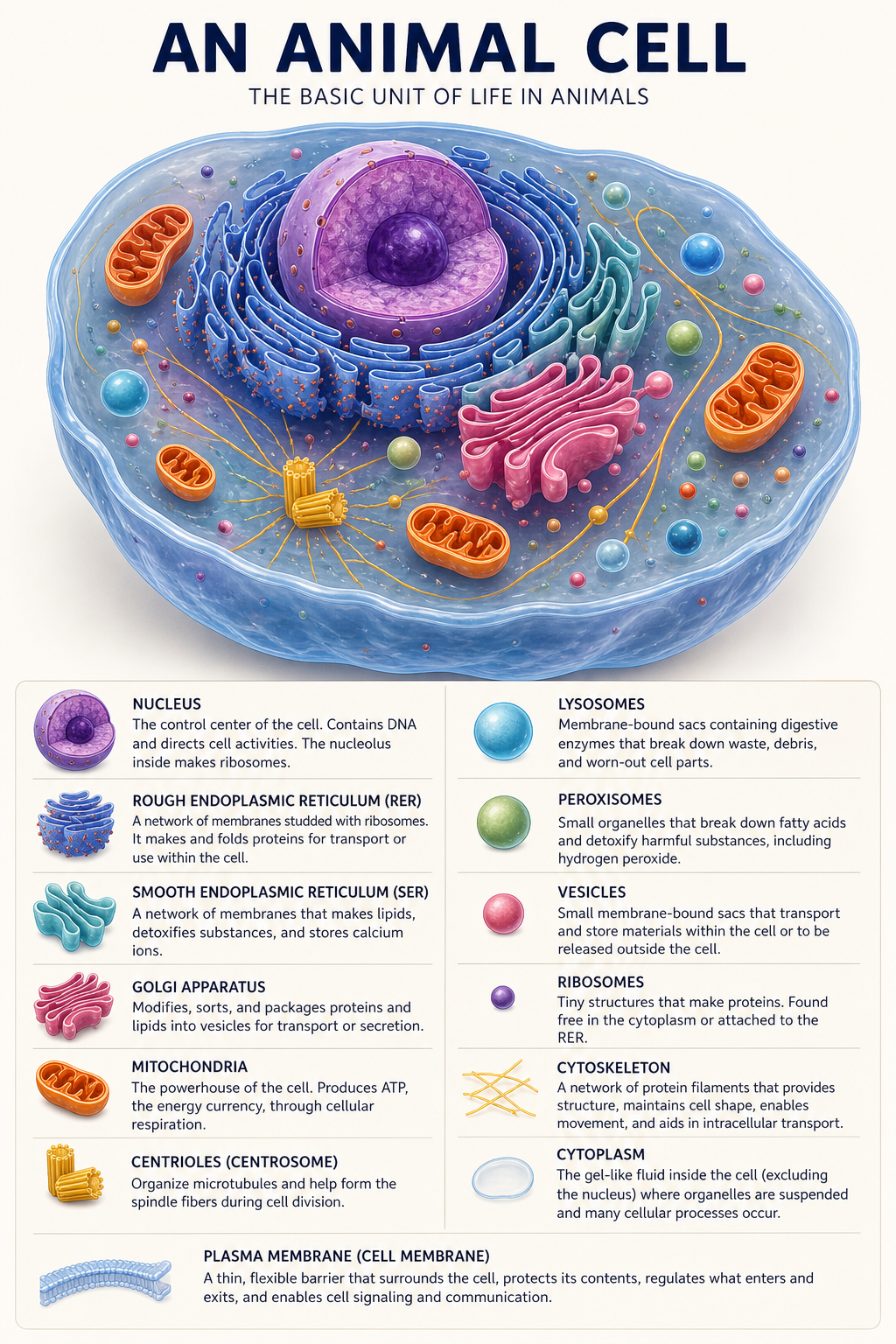
An animal cell is a flexible, irregular shape held together by a thin outer boundary called the plasma membrane. Animal cells do not have a rigid cell wall, which is part of why animals can move, stretch, and bend the way they do.
Inside the cell is a busy world. Take a look at the diagram below, then we will visit each organelle one by one.
Boundary and Cytoplasm
~5 minutes1. Plasma Membrane (Cell Membrane)
The plasma membrane is the thin, flexible boundary that surrounds every animal cell. It separates the inside of the cell from the outside environment.
It is built from a phospholipid bilayer with proteins floating in it. The membrane is selectively permeable, which means it lets some things through (like oxygen and water) while blocking or carefully controlling others.
Some proteins in the membrane act as channels or pumps that move materials in and out. Others act as receptors that detect chemical signals from outside the cell, like hormones.
Key role: Controls what enters and exits the cell, and helps the cell communicate with its surroundings.
2. Cytoplasm
The cytoplasm is the gel-like material that fills the inside of the cell, outside the nucleus. It includes a watery fluid called the cytosol plus all the organelles suspended in it.
Cytoplasm is not just empty filler. It contains water, salts, dissolved nutrients, proteins, enzymes, and many other molecules. Many chemical reactions happen here. For example, the first stage of cellular respiration, called glycolysis, happens in the cytoplasm before the rest of the process continues in the mitochondria.
Key role: Provides the workspace where organelles operate and where many chemical reactions take place.
What is the main job of the plasma membrane?
Nucleus: The Control Center
~7 minutes3. Nucleus
The nucleus is often called the control center of the cell because it stores the cell's genetic information as DNA. The DNA contains the instructions for building every protein the cell needs and for controlling all of its activities.
The nucleus is wrapped in a double membrane called the nuclear envelope. Small openings called nuclear pores allow specific molecules to pass in and out, like messenger RNA carrying gene instructions to the ribosomes.
Inside the nucleus, DNA is organized into thread-like structures called chromosomes. When the cell is not actively dividing, the DNA exists in a more loosely coiled form called chromatin.
Key role: Stores DNA and controls what proteins the cell makes, when it grows, and when it divides.
4. Nucleolus
Inside the nucleus, you can usually see a dense, rounded spot called the nucleolus. It is not surrounded by its own membrane, but it stands out because it is packed with RNA and proteins.
The main job of the nucleolus is to build the parts of ribosomes. It produces ribosomal RNA and combines it with proteins to make ribosome subunits. Those subunits leave the nucleus through nuclear pores and assemble into working ribosomes in the cytoplasm.
Cells that make a lot of proteins (like cells that produce hormones or enzymes) often have especially active nucleoli.
Key role: Builds ribosomes, which are needed to make all of the cell's proteins.
Why is the nucleus often called the 'control center' of the cell?
The dense region inside the nucleus where ribosome subunits are built is called the ______.
Protein Production and Shipping
~12 minutes5. Ribosomes
Ribosomes are tiny structures that build proteins. They are the smallest organelles shown on most cell diagrams, but they are essential for life.
A ribosome reads a messenger RNA message and uses it to assemble amino acids into a chain. That chain folds into a working protein. This process is called translation.
Ribosomes can be found in two places:
• Free in the cytoplasm, where they make proteins used inside the cytoplasm.
• Attached to the rough endoplasmic reticulum, where they make proteins that will be sent to other organelles or out of the cell.
Ribosomes are not surrounded by a membrane, so they are not considered membrane-bound organelles. But they are still some of the most important structures in the cell.
Key role: Build all of the cell's proteins by translating mRNA instructions into amino acid chains.
6. Rough Endoplasmic Reticulum (RER)
The rough endoplasmic reticulum, or rough ER, is a network of folded membranes located near the nucleus. It is called rough because ribosomes are attached to its surface, giving it a bumpy, dotted appearance.
When a ribosome on the RER builds a protein, the new protein can enter the inside of the ER. There, it begins to fold into its proper shape. Some proteins also receive early chemical changes, like the addition of sugar groups.
The RER also performs quality control: misfolded proteins can be corrected, held back, or marked for breakdown.
Once a protein is ready, the RER pinches off a small transport vesicle that carries the protein to the Golgi apparatus for further processing.
Key role: Builds, folds, and modifies proteins, especially those that will leave the cell or be sent to other organelles.
7. Smooth Endoplasmic Reticulum (SER)
The smooth endoplasmic reticulum, or smooth ER, is another network of folded membranes, but it does not have ribosomes attached. That is why it looks smoother than the rough ER.
The smooth ER has several important jobs:
• Makes lipids, including the phospholipids that build cell membranes.
• Detoxifies harmful substances. In liver cells, the smooth ER helps process alcohol, drugs, and other chemicals so the body can get rid of them.
• Stores calcium ions that the cell uses for signaling. In muscle cells, a special form of smooth ER releases calcium to trigger muscle contraction.
Key role: Builds lipids, detoxifies harmful chemicals, and stores calcium for cell signaling.
8. Golgi Apparatus
The Golgi apparatus (sometimes called the Golgi body or Golgi complex) is a stack of flattened membrane sacs. Think of it as the cell's shipping and processing center.
Proteins and lipids arrive at the Golgi in transport vesicles from the ER. As they pass through the stack of sacs, they are modified (for example, sugar chains are added or trimmed), sorted by destination, and then packaged into new vesicles.
Some vesicles carry their cargo to the plasma membrane for release outside the cell. Others go to lysosomes or other internal destinations.
Key role: Modifies, sorts, and packages proteins and lipids, then ships them to the right place in or out of the cell.
What is the main job of a ribosome?
The rough endoplasmic reticulum is called 'rough' because it has ribosomes attached to its surface.
Which of the following are functions of the smooth endoplasmic reticulum? Select all that apply.
Select all that apply.
If a cell were a city, which organelle would best match the role of a 'shipping and processing center'?
Place these steps of the protein production and shipping pathway in the correct order, from first to last.
In your own words, explain the difference between the rough endoplasmic reticulum and the smooth endoplasmic reticulum. Mention at least one job each one does.
Expected length: 30-100 words
Energy Production: Mitochondria
~6 minutes9. Mitochondria
Mitochondria are the powerhouses of the cell. They produce most of the cell's usable energy in the form of ATP through cellular respiration. ATP is the molecule cells use to power almost every activity, from muscle contraction to building new proteins.
Mitochondria have a double membrane:
• The outer membrane is smooth and surrounds the whole organelle.
• The inner membrane is folded into structures called cristae (singular: crista). The folds dramatically increase the surface area available for energy-producing reactions.
The fluid space inside the inner membrane is called the matrix.
Cells that need a lot of energy (muscle cells, nerve cells, heart cells) usually contain many mitochondria. Mitochondria even have their own small loop of DNA and their own ribosomes, which is evidence that they evolved from ancient bacteria that became part of early eukaryotic cells.
Key role: Break down sugars to produce ATP, the energy currency that powers the cell.
Why are mitochondria sometimes called the 'powerhouses' of the cell?
The folds of the inner mitochondrial membrane are called ______. They increase surface area for energy-producing reactions.
Cleanup Crew: Lysosomes, Peroxisomes, and Vesicles
~6 minutes10. Lysosomes
Lysosomes are small membrane-bound sacs that contain digestive enzymes. Their job is to break down waste materials, damaged organelles, and substances brought into the cell.
The enzymes inside a lysosome work best in acidic conditions. The lysosome's membrane keeps those enzymes safely contained so they do not damage the rest of the cell.
Lysosomes are like the cell's recycling and demolition center. When a worn-out organelle is no longer useful, the cell can wrap it up and send it to a lysosome for breakdown. The useful pieces, like amino acids, can then be reused.
Lysosomes also help certain immune cells digest bacteria and other harmful invaders.
Key role: Digest waste, recycle worn-out cell parts, and destroy harmful invaders.
11. Peroxisomes
Peroxisomes are small membrane-bound organelles that break down fatty acids and detoxify harmful substances. They use enzymes that carry out oxidation reactions.
One byproduct of these reactions is hydrogen peroxide, which can damage the cell if it builds up. Peroxisomes contain an enzyme called catalase that breaks hydrogen peroxide into harmless water and oxygen.
Peroxisomes are especially important in liver and kidney cells, which handle a lot of detoxification.
Important: Lysosomes and peroxisomes both help dispose of unwanted material, but in different ways. Lysosomes use acidic enzymes to digest large materials. Peroxisomes use oxidation reactions to break down specific molecules and neutralize toxins.
Key role: Break down fatty acids and neutralize harmful substances like hydrogen peroxide.
12. Vesicles
Vesicles are small membrane-bound sacs used to transport and store materials inside the cell. They are like tiny cargo containers.
Vesicles can form when part of a membrane (like the ER, Golgi, or plasma membrane) pinches off. They can also fuse with another membrane to deliver their contents.
There are several types:
• Transport vesicles move materials between organelles, like from the ER to the Golgi.
• Secretory vesicles carry materials to the plasma membrane to be released outside the cell. This release is called exocytosis.
• Endocytic vesicles form when the plasma membrane folds inward to bring outside materials into the cell. This intake is called endocytosis.
Key role: Move and store materials inside the cell, and exchange materials with the outside.
Which organelle is mainly responsible for digesting waste and recycling worn-out cell parts?
What is one key difference between lysosomes and peroxisomes?
Cell Structure and Division
~5 minutes13. Cytoskeleton
The cytoskeleton is a network of protein fibers that gives the cell shape, support, and the ability to move. It is not a single rigid skeleton like the bones in your body. It is more like a dynamic framework that constantly rearranges itself.
The cytoskeleton has three main types of fibers:
• Microfilaments (made of actin) — help with cell movement, changes in cell shape, and muscle contraction.
• Intermediate filaments — provide mechanical strength and resist stretching.
• Microtubules (made of tubulin) — hollow tubes that organize the cell, serve as tracks for moving vesicles, and form the spindle fibers that separate chromosomes during cell division.
Motor proteins can walk along cytoskeletal tracks while carrying vesicles or organelles, like tiny delivery trucks moving along internal highways.
Key role: Maintains cell shape, helps the cell move, organizes organelles, and provides tracks for moving materials inside the cell.
14. Centrioles and the Centrosome
Centrioles are short, cylinder-shaped structures made of microtubules. In animal cells, a pair of centrioles sits inside a region called the centrosome, located near the nucleus.
The centrosome acts as a microtubule-organizing center. It helps arrange the microtubules of the cytoskeleton and plays a key role in cell division.
When an animal cell divides, the centrosome helps build the spindle apparatus, a structure made of microtubules that pulls duplicated chromosomes to opposite ends of the cell so each new cell receives a complete set.
Centrioles are also related to structures called cilia and flagella, which some cells use to move or to move fluid across their surfaces.
Plant cells can divide without prominent centrioles, so this organelle is most often shown in animal cell diagrams.
Key role: Organize microtubules and help form the spindle that separates chromosomes during cell division.
Which statement best describes the cytoskeleton?
Centrioles help organize microtubules and form the spindle that separates chromosomes during cell division.
Animal Cell Check Your Understanding
~5 minutesAn animal cell has a flexible plasma membrane, a nucleus that controls activity, ribosomes that build proteins, ER and Golgi that process and ship proteins, mitochondria that make ATP, lysosomes and peroxisomes that handle waste and toxins, vesicles for transport, a cytoskeleton for structure and movement, and centrioles to help with cell division. Animal cells do not have a cell wall, chloroplasts, or a single large central vacuole.
Match each organelle to its main function.
Plant Cell Overview
~3 minutesPart 2: The Plant Cell
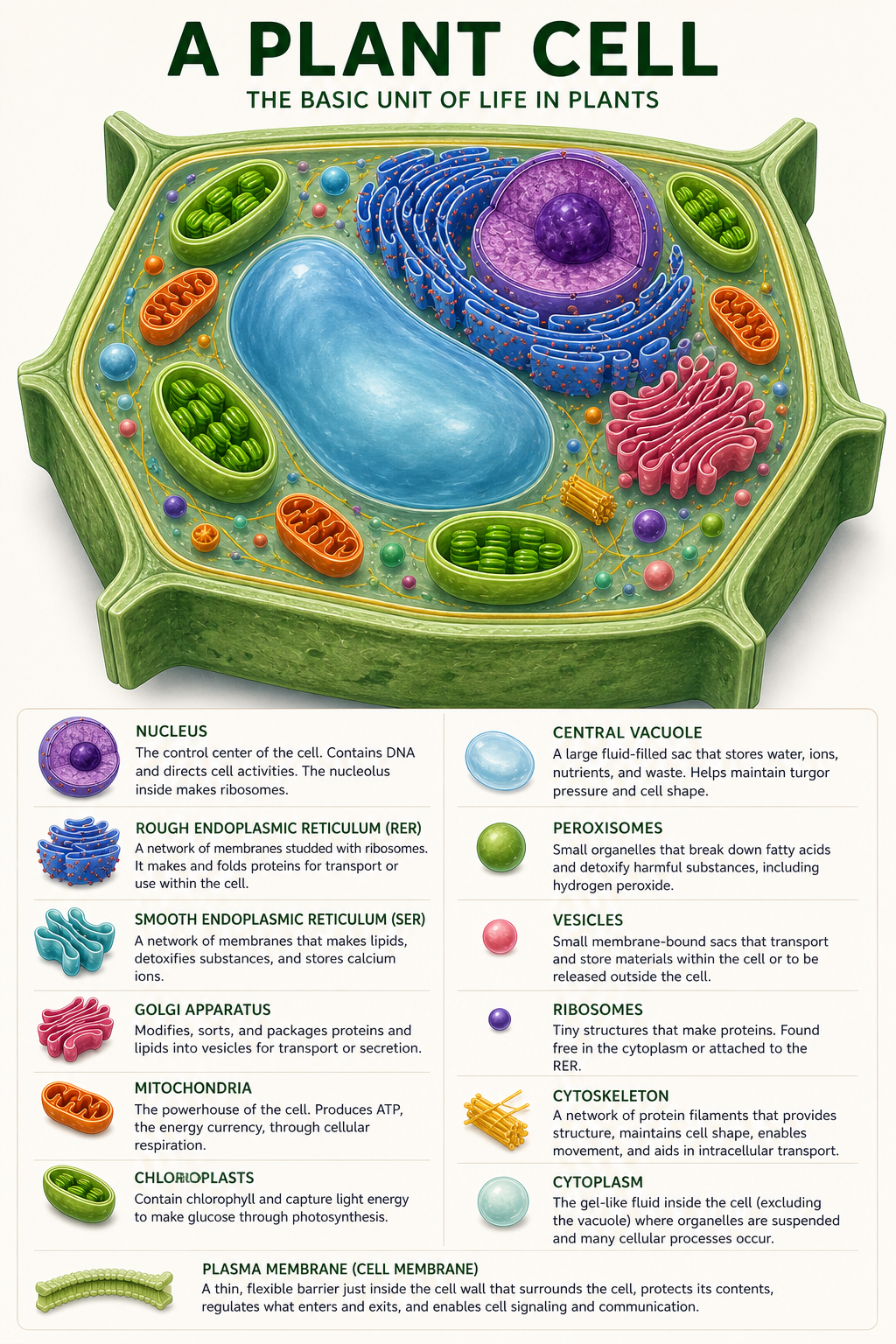
A plant cell shares most of its parts with an animal cell. Plant cells have a nucleus, ribosomes, ER, Golgi apparatus, mitochondria, peroxisomes, vesicles, a cytoskeleton, cytoplasm, and a plasma membrane.
But plant cells also have three big additions that animal cells do not have:
1. A cell wall outside the plasma membrane. 2. Chloroplasts that perform photosynthesis. 3. A large central vacuole that takes up most of the inside of the cell.
These three structures are what allow plants to capture sunlight, stand upright, and store huge amounts of water. Take a look at the plant cell diagram below.
The Cell Wall
~4 minutesCell Wall (unique to plant cells)
The cell wall is a rigid outer layer found outside the plasma membrane. It is one of the biggest features that separates plant cells from animal cells.
Plant cell walls are made mostly of cellulose, a tough carbohydrate, along with other materials like hemicellulose, pectin, and structural proteins. The wall is strong but slightly flexible, kind of like cardboard.
The cell wall:
• Provides rigid support so plants can stand up tall.
• Gives the cell its box-like shape.
• Prevents the cell from bursting when it takes in a lot of water.
Cell walls also have small channels called plasmodesmata, which connect neighboring plant cells. These channels let molecules and signals pass directly from one cell to the next.
Key role: Provides structural support, protection, and allows plant cells to communicate with their neighbors.
What is the plant cell wall mostly made of?
The Central Vacuole
~5 minutesCentral Vacuole (unique to plant cells)
The central vacuole is one of the most distinctive parts of a mature plant cell. It is a large, fluid-filled compartment that often takes up most of the cell's volume, pressing the cytoplasm and other organelles into a thin layer around the edges.
The central vacuole is surrounded by a membrane called the tonoplast.
It stores water, ions, sugars, pigments, and waste products. Its most important job is to maintain turgor pressure: the outward pressure caused when the vacuole is full of water and pushes the cytoplasm against the cell wall. Turgor pressure is what keeps stems firm and leaves stretched out.
When a plant has plenty of water, the central vacuole is full and the plant looks crisp and upright. When a plant loses too much water, the vacuoles shrink, turgor pressure drops, and the plant wilts.
Some plants also use the central vacuole to store bitter or toxic chemicals that help defend them against insects and other animals that might want to eat them.
Key role: Stores water and dissolved substances, maintains turgor pressure, and helps support the plant.
When a plant has plenty of water, the central vacuole fills up and pushes against the cell wall. This pressure is called:
A houseplant that has not been watered for a few days starts to droop and wilt. Use what you know about the central vacuole and turgor pressure to explain why.
Expected length: 30-80 words
Chloroplasts: Capturing Sunlight
~6 minutesChloroplasts (unique to plant cells)
Chloroplasts are the organelles that carry out photosynthesis. They contain a green pigment called chlorophyll that absorbs light energy from the sun.
During photosynthesis, chloroplasts use light energy plus carbon dioxide and water to make glucose (sugar) and oxygen. The glucose stores chemical energy that the plant can use for growth, and the oxygen is released into the air, where it supports nearly all aerobic life.
Inside chloroplasts:
• Stacks of flattened sacs called thylakoids. A single sac is a thylakoid; a stack is a granum (plural: grana). Thylakoid membranes contain the chlorophyll.
• The fluid around the grana is called the stroma, where the sugar-building reactions occur.
Like mitochondria, chloroplasts have their own DNA and ribosomes. This is evidence that they evolved from ancient photosynthetic bacteria that became part of early plant ancestors.
Key role: Capture light energy and use it to make sugar through photosynthesis, releasing oxygen as a byproduct.
What molecule inside chloroplasts captures light energy from the sun?
Inside a chloroplast, flat sacs called ______ are stacked into structures called grana, which contain the chlorophyll that absorbs light.
Plants Have BOTH Mitochondria AND Chloroplasts
~4 minutesA common misconception is that plants only have chloroplasts and animals only have mitochondria. Plant cells contain both. Chloroplasts capture light energy and store it in glucose. Mitochondria break down glucose to release ATP that the cell can use. Plants need their mitochondria just as much as animals do, especially at night and in non-green tissues like roots.
Plant cells do not contain mitochondria because their chloroplasts already make all the energy they need.
Which statement best describes how chloroplasts and mitochondria work together in a plant cell?
What Plant and Animal Cells Share
~3 minutesOrganelles Plant Cells Share with Animal Cells
The rest of the plant cell organelles work the same way they do in animal cells, with a few small plant-specific twists. Here is a quick recap:
- Plasma membrane — Just inside the cell wall. Controls what enters and exits.
• Nucleus and nucleolus — Stores DNA and builds ribosomes.
• Ribosomes — Build proteins from mRNA instructions.
• Rough ER — Makes and folds proteins. In plant cells, the RER also helps make proteins destined for the cell wall and the central vacuole.
• Smooth ER — Makes lipids and other specialized molecules. In some plant tissues it helps make oils and waxes.
• Golgi apparatus — Modifies, sorts, and packages molecules. In plants, the Golgi is especially important for producing cell wall materials like pectins and hemicelluloses.
• Mitochondria — Make ATP through cellular respiration. Plants need mitochondria for energy even though they also have chloroplasts.
• Peroxisomes — Break down fatty acids and detoxify substances. In plants, peroxisomes also participate in photorespiration, a process linked to photosynthesis.
• Vesicles — Transport materials. In plants, vesicles deliver cell wall materials to the wall and help build the cell plate that separates daughter cells during division.
• Cytoskeleton — Maintains internal organization. In plants, it helps guide where new cell wall material is deposited as the cell grows.
• Cytoplasm — The gel-like environment for organelles. In plant cells, the cytoplasm is often pressed into a thin layer around the edge because the central vacuole takes up so much space. Plants also have a phenomenon called cytoplasmic streaming that moves materials around.
Plant cells typically do not have prominent centrioles like animal cells, and instead of lysosomes they often use lytic vacuoles for digestion and recycling.
What are plasmodesmata?
Side-by-Side Comparison
~10 minutesPart 3: Comparing Animal and Plant Cells
Now that you have toured both cell types, let's compare them side by side. Most organelles are shared, but a few key differences make plant cells and animal cells suited to very different lifestyles.
Plant vs Animal: Quick Comparison Table
| Structure | Animal cell | Plant cell |
|---|---|---|
| Plasma membrane | Yes | Yes |
| Cell wall | No | Yes (made of cellulose) |
| Nucleus and nucleolus | Yes | Yes |
| Ribosomes | Yes | Yes |
| Rough ER | Yes | Yes |
| Smooth ER | Yes | Yes |
| Golgi apparatus | Yes | Yes |
| Mitochondria | Yes | Yes (plants have them too!) |
| Chloroplasts | No | Yes |
| Vacuoles | Small, sometimes several | One large central vacuole |
| Lysosomes | Yes | Often replaced by lytic vacuoles |
| Peroxisomes | Yes | Yes (also do photorespiration) |
| Vesicles | Yes | Yes |
| Cytoskeleton | Yes | Yes |
| Centrioles | Prominent | Usually absent or hard to see |
| Plasmodesmata | No | Yes (connect to neighbors) |
| Overall shape | Flexible, irregular | Box-like, fixed |
Which of the following are found in PLANT cells but NOT in animal cells? Select all that apply.
Select all that apply.
Which of the following organelles are found in BOTH animal AND plant cells? Select all that apply.
Select all that apply.
Match each structure to the cell type it is most associated with.
Why do plant cells tend to be more box-shaped, while animal cells tend to be irregular and flexible?
Imagine looking at two cells under a microscope. One has a rigid box-like shape with green organelles inside. The other is a flexible irregular blob with no green organelles. Which is the plant cell and which is the animal cell? Explain your reasoning using at least TWO specific structures.
Expected length: 40-120 words
The Cell as a Coordinated System
~8 minutesPart 4: How the Parts Work Together
A cell is not just a collection of separate parts. The organelles form an integrated system, with each part depending on the others. Here is how a few of the most important pathways link up.
Making and shipping a protein
1. The DNA in the nucleus is copied into messenger RNA. 2. The mRNA exits through a nuclear pore and reaches a ribosome on the rough ER. 3. The ribosome builds the protein; the rough ER folds it. 4. A vesicle carries the protein to the Golgi apparatus. 5. The Golgi modifies, sorts, and packages the protein into a new vesicle. 6. The new vesicle delivers it to its destination — the plasma membrane, a lysosome, the vacuole, or outside the cell.
Powering the cell
1. Glucose enters the cell through the plasma membrane. 2. Glycolysis (the first stage of cellular respiration) breaks down some of the glucose in the cytoplasm. 3. The products move into the mitochondria, where the rest of cellular respiration produces large amounts of ATP. 4. ATP is used by every other organelle to power their work.
In plant cells, there is an extra step at the front: the chloroplast uses light energy to make glucose in the first place, through photosynthesis.
Cleaning up
- Lysosomes digest old organelles and recycle their parts.
• Peroxisomes break down fatty acids and detoxify hydrogen peroxide.
• The central vacuole in plants stores waste and isolates harmful chemicals.
Without coordination among all these organelles, the cell could not survive. Each organelle is specialized, but no organelle works alone.
The nucleus is City Hall: it makes the rules and stores the records. The ribosomes are factories that build products (proteins). The rough ER is the assembly line, the Golgi is the post office, and vesicles are the delivery trucks. Mitochondria are the power plants. Lysosomes and peroxisomes are the recycling and waste treatment centers. The plasma membrane is the city wall and security gate. In plant cells, add a sturdy outer fence (cell wall), a giant water tower (central vacuole), and solar panels on every rooftop (chloroplasts). Like a city, no single building runs everything. The cell works because all the parts coordinate.
Match each cell-as-city analogy to the correct organelle.
Place these steps of how a cell powers itself in the correct order.
Pick any TWO organelles from this lesson and explain how their jobs depend on each other. Be specific about what each organelle does and how the work of one connects to the work of the other.
Expected length: 50-150 words
What If an Organelle Failed?
~7 minutesImagine all of a cell's mitochondria suddenly stopped working. Which is the MOST likely immediate consequence?
If a cell's ribosomes stopped working, what would happen?
A scientist is studying a plant cell whose cell wall has been removed (leaving only the plasma membrane). The cell is then placed in pure water. Predict what is likely to happen to the cell, and explain why using ideas about the central vacuole, turgor pressure, and the role of the cell wall.
Expected length: 50-150 words